By Linda Batchelor
In a letter dated 12th October 1937 to the editor of The Manchester Guardian entitled ‘Slum-Clearance in Cornwall’, the Marquise De Verdieres of the Newlyn and District Housing Advisory Committee stated that “Newlyn, by an astonishing order of the Penzance Town Council under the Slum Clearance Act is to be swept away”.
She later stated “It is true that certain parts of Newlyn and Mousehole should be cleared and the inhabitants provided with new and good homes. This would be real and welcome progress – very different from the wholesale sweeping destruction which is contemplated and the appalling hardship it will involve”. The letter was part of a campaign to save homes in the Newlyn community which involved a mission to Westminster by the Newlyn fishing boat the Rosebud.
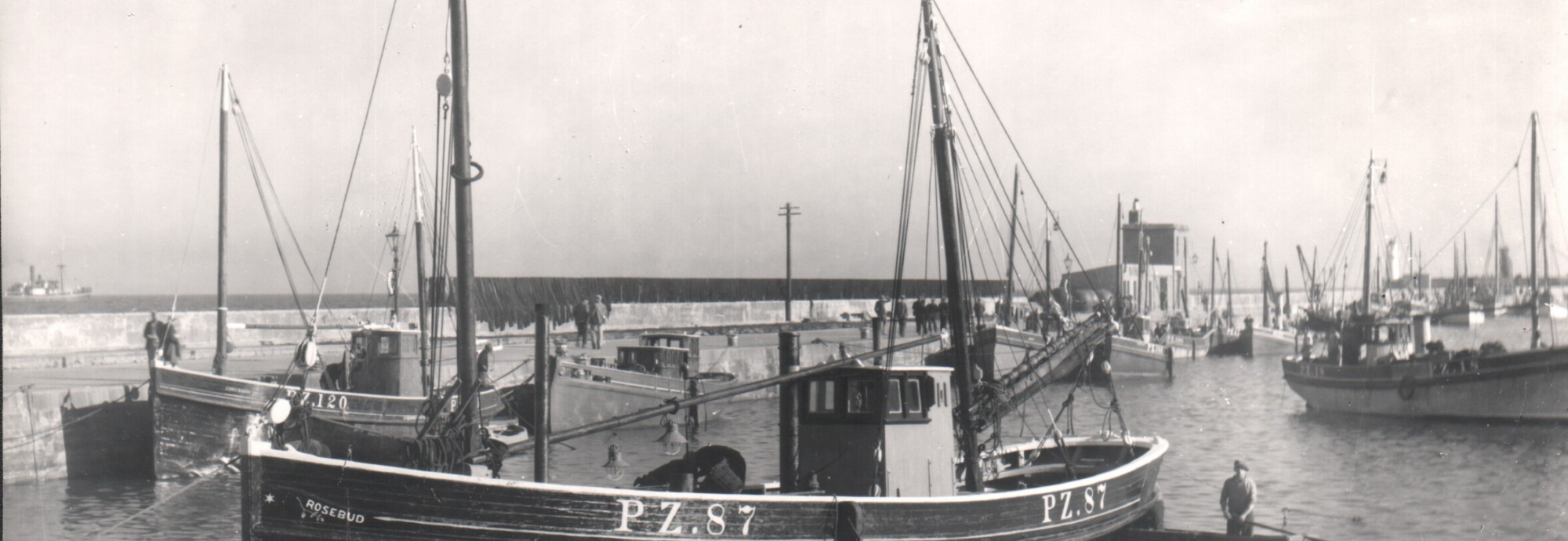
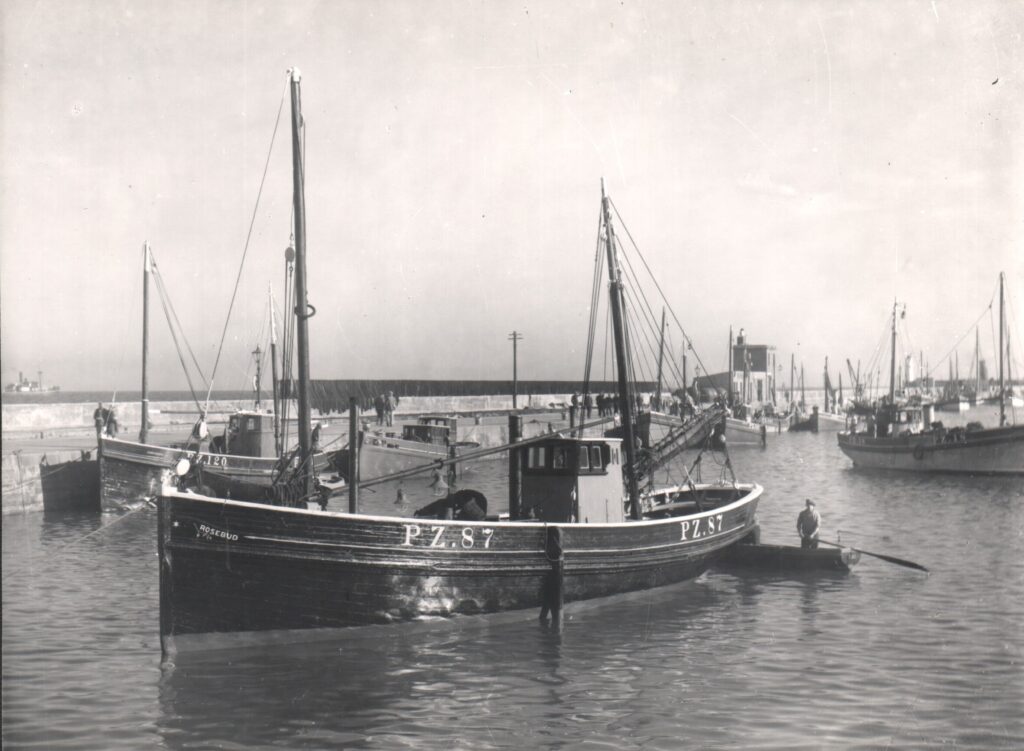
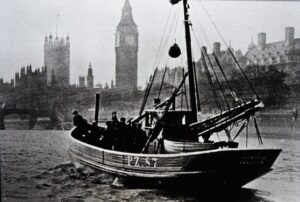
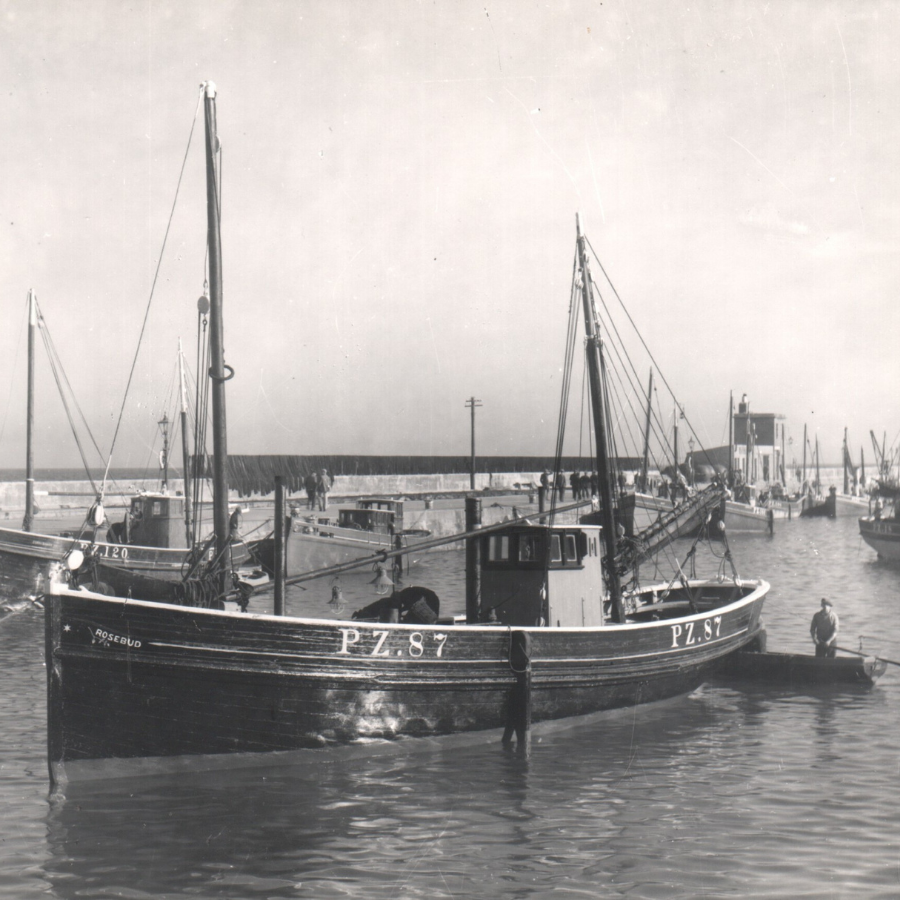
On 22nd October 1937 the Rosebud the vessel with the registration of PZ87 tied up not at its usual berth in Newlyn Harbour, Cornwall but at Westminster Pier on the Thames in London without its usual catch of fish but with a very different cargo. Rosebud and its crew of nine were carrying a petition on a mission to save their traditional family homes from what became known as the Newlyn Clearances.
Newlyn and Penzance
Newlyn and its near neighbour Penzance are situated on the shore of Mounts Bay in the south west of Cornwall. Both have a long history but whereas Penzance developed as a port and market town, Newlyn origins were as a fishing village which developed into a major fishing harbour. Although the two towns were physically very close there was a distinct difference in their nature, population composition and outlook and there was a tradition of mutual rivalry, evident throughout the centuries which persisted in the first half of the twentieth century. Penzance was a more cosmopolitan and genteel town with wider professional and commercial aspects whereas Newlyn and its harbour was based on the traditional working nature of the fishing industry.
Beginning in 1929 and during the early 1930s local government in England and Wales was undergoing reform to restructure and reorganize existing systems. A multitude of older parish based authorities were abolished or united to form County and Borough Councils to govern larger areas and provide local services. In 1934 Penzance was given a new and enlarged Borough Council which encompassed many of the neighbouring parishes including Newlyn.
Demolition Plans
One of the areas the new Penzance Corporation began to address almost immediately was the issue of sub-standard housing and the need for the demolition of housing ‘unfit for human habitation’ and the provision of new municipal estates. The Borough Council dealt first with matters in Penzance itself and then in 1935 undertook assessment of housing in Newlyn conducted by the Medical Officer of Health. The result was that many of the homes in Newlyn were condemned and compulsory purchase orders were issued whilst an area outside the centre was identified as the place for almost two hundred and fifty new houses, named as the Gwavas Estate.
The controversy regarding the Corporation plans was not just a straightforward one between the old and the new. Whilst many of the residents, especially those whose livelihoods were based on fishing, were concerned at the destruction of the traditional heart and community life of Newlyn around the harbour others were in favour of the new estate which offered better living conditions and more modern facilities. The colony of artists which had developed and settled in Newlyn during the latter half of the nineteenth century were also an established part of the community and although not directly affected by the plans were opposed largely on aesthetic grounds.
The major problems with how the buildings were selected for demolition, particularly the sweeping and indiscriminate nature of some clearance orders, the types of occupancy, tenancy or ownership, the adequacy or lack of compensation and relocation issues all added to the division and controversy in Newlyn. Protests and representations were considered by the authorities but generally not acted upon. The planned changes were implemented with bureaucratic efficiency but lacking in a nuanced approach to Newlyn’s particular needs and historic background.
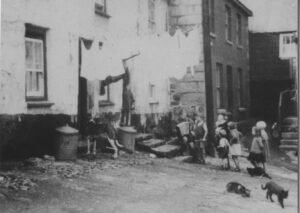
The Square, St.Peter’s Hill. 1935., Morrab Library Photographic Archive. Now Rosebud Gardens.
The Opposition Campaign
Opposition grew and the issue began to attract more popular publicity becoming represented as a community struggle against overpowering bureaucracy. Two members of the Newlyn artistic community, Geoffrey Garnier and Phyllis, Marquise de Verdieres, became prominent in the organization of the opposition campaign
Geoffrey Garnier a prominent figure regarded with authority in Newlyn affairs set up an emergency committee, the Newlyn and District Housing Advisory Committee. An engraver and printmaker he had attended Stanhope Forbes Art School, married a fellow student and lived in Orchard Cottage in Newlyn since 1917. He had an engineering background and had served in the Great War in both the Army and Royal Navy.
Phyllis was the daughter of the Newlyn School artists Thomas and Caroline Gotch. Both were from wealthy backgrounds and had settled permanently in Newlyn, building a large house at Wheal Betsy on the hill outside the town, where Phyllis was brought up, an only child figuring in many of her father’s paintings. After training as a singer in 1912 she had gone to South Africa. There she had married a mining engineer Ernest Doherty and they had a child, Patsy. She had returned to Newlyn to visit her parents in 1914 but when war was declared she was unable to return to South Africa and was widowed whilst in England. In 1922 she had remarried a French Marquis but they parted after only three years. She styled herself Marquise de Verdieres for the rest of her life despite marrying for the third time in 1936 to Justin Bodilly.
‘Miss Phyllis’ grew up a tomboy and later became the subject of gossip as a daring young woman well known for flamboyance and confidence but with a deep understanding and regard of her Newlyn roots. By the time of the proposed plans for Newlyn ‘Miss Phyllis’ was a local councillor who opposed the wholesale ‘slum’ clearances, had joined the advisory committee and with experience of writing and connections with national magazines and newspapers was handling the publicity campaign.
The Richards family, boat owners and fishermen with their own condemned home, a fine granite building, became spokesmen for the Newlyn community directly affected by the clearance plans.
The Advisory Committee also commissioned Stanley Adshead Professor Emeritus of Town Planning at London University to give his opinions on the plans. His report made it clear that widespread clearance was not always mandatory and there should be exceptions and special provision made regarding places and buildings of historic interest.
Need for Action
Despite all the representations, objections, arguments and enquiries the plans for widespread clearance remained. The Committee decided that more drastic action was needed and the matter should be put to the Minister of Health in person. The previous year the Jarrow March from the North East to London to present a petition had gathered the nation’s attention on the issues of unemployment. Inspired by the concept the idea of sending a delegation to the Minister by fishing boat from Newlyn to London took hold and the Rosebud owned by the Richards was chosen for the task.
Rosebud was a sturdy 50-foot fishing boat built in 1919 which was part of the Newlyn fleet which during the autumn season would head to the East Coast herring ports of Lowestoft and Yarmouth. This time the destination was London with the journey there and back and the time required in London to present the petition estimated at nearly two weeks. There was a need for funds for fuel, provisions and to replace lost income. The Marquise assisted by the Committee set up a fund raising drive and publicity campaign which attracted both local and national contributions. Soon the Rosebud was ready for the expedition.
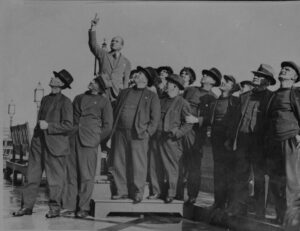
The crew of nine were chosen with a view of their ultimate task of petition presentation at the Houses of Parliament. They were Cecil and William Richards (part owners of the boat), James Matthews, Ben Batten, Joe Harvey, William Roberts, James Simons, Jan Tonkin and William Williams. On board was the petition signed by eleven hundred Newlyn householders, fuel, food and tokens such as a bottle of water from the Holy Well at Madron and another with water from the River Jordan. The petition was to be received at the House of Commons on 21st October.
In the dawn of 19th October Rosebud began the mission from the South Pier in Newlyn on the first leg of her journey along the coast to Plymouth. They arrived in Sutton Harbour at 6.00 pm meaning to have their compasses adjusted then but were delayed until the pilot was available the next morning at 9.00am. The delay was worrying as the Minister of Health was due to receive the petition at tea-time the following day and they would miss the deadline. However, the Minister had heard of their delay through Lloyds Register and adjusted the appointment from Wednesday to Thursday.
Meanwhile the Rosebud and her crew continued steadily along the Channel coast. After a brief stop at Dover to pick up Thames charts and followed by a temporary grounding on leaving Dover harbour they began to head for the mouth of the Thames with most of the crew on deck all night following the unfamiliar course. They entered the Thames in the dawn of Thursday and began the haul to London. Their passage was marked all the way by other vessels, by dockers and rivermen and as they neared their destination the banks of the river were lined with waving and cheering members of the public the crew were amazed at the size of the reception and waved and raised their fists in acknowledgement. Just after 11 o’clock Rosebud was led to Westminster Pier by a police launch and followed by a river launch hired by the press and full of cameramen.
They were met at the Pier by the Marquise and members of the Committee alongside friends, relatives and many with Cornish connections including Alan Beecham MP. They were escorted to lunch with the London Cornish Association at a restaurant and then a short tour by Alan Beecham of the Houses of Parliament. The time had come for them to meet Sir Kingsley Wood the Minister of Health at his offices in Whitehall where they were given a tea of Cornish fare, ‘pasties and cream’ according to the press.
The men presented Sir Kingsley with the petition which he put aside after the meeting together with a following counter petition from about four hundred younger families regarding quicker moves to better housing. Sir Kingsley was faced with a dilemma where both sides of the problem had a justified case. There needed to be a balance between destruction and conservation, not an easy political solution for the Minister. As a result only twenty three of the one hundred and fifty seven of the condemned houses were saved by the Minister before he passed the overall dilemma back to the local authority.
The Outcome
The cull of houses around the harbour community continued. Despite the popularity of the Rosebud mission and despite characters such as the Marquise fighting on when public interest waned old Newlyn was not ‘saved’ but had already been devastated. However with the advent of the Second World War work ceased on the schemes that had been devised by Penzance Council and the sweeping proposals never came into being.
The Rosebud mission was initially hailed as a success in the press and the crew returned home with honour but ultimately it failed in its aim of saving many dwellings in Newlyn from demolition. Fortunately, the publicity generated by the mission and then the advent of war saved neighbouring villages such as Mousehole from such sweeping clearances. Despite the devastation suffered in the clearances to some areas of old Newlyn other parts remained, and still remain, virtually untouched or restored. Newer building has continued and hopefully the lesson of a balance of demolition and conservation prevails. Newlyn survives with a mix of old and new and continues as a lively community with the fishing industry at its heart.
The voyage of the Rosebud was significant as a symbol of a local community defending itself against the inconsiderate application of national rules, the importance of considering local needs and the balance of conservation alongside improvement.
Images with thanks to the Morrab Library Photographic Archive
Further reading:
The Rosebud and the Newlyn Clearances by Michael Sagar-Fenton ISBN 1 85022 183 9
The Bartlett Blog is researched, written and produced by volunteers who staff The Bartlett Maritime Research Centre and Library of National Maritime Museum Cornwall. This blog post was written by Linda Batchelor, a Bartlett Library volunteer.
The Bartlett Maritime Research Centre & Library holds a Collection of over 20,000 volumes and offers access to one of the finest collections of maritime reference books, periodicals and archival material. The Bartlett Blog reflects the diversity of material available in The Bartlett Library.

National Maritime
Museum Cornwall Trust
Discovery Quay
Falmouth Cornwall
TR11 3QY
View Map
See our opening hours
Tel: +44(0)1326 313388
Email: enquiries@nmmc.co.uk