By Linda Batchelor
At the beginning of May 2026 over 450 crews registered for the 35th Annual World Pilot Gig Championship, held over three days in the Isles of Scilly.
Rowers from Cornwall and across the UK, and others from elsewhere including Ireland, the United States and Europe gathered to compete in gig rowing in what was once a form of essential employment around the coast and is now well established as a sport for an international community with over 8,000 gig rowers.
Racing gigs in Falmouth.
Development and Use of the Gig
Dating from the late seventeenth century, gigs were open rowing boats used around various areas of the British coasts as working boats carrying cargo to and from ships sailing around the coast and especially for taking pilots out to ships heading into port. In the latter case speed was of the essence as pilots competed for business and the work would go to the first pilot aboard a ship.
Gigs are powered by fixed seat rowing using the leverage of the sea with the primary purpose of being rowed at speed and as working boats they could also have a sail. Crewed by six rowers with feet braced against stretchers and with single banked oars they are helmed by a coxswain. Constructed of wood, clinker built of Cornish narrow leaf elm, with planking a fraction of an inch thick and with a beam of 4 foot 10 inches for a length of 32 foot they are designed to be both swift and flexible but also to have lightness alongside strength.
The combination of speed, manoeuvrability and strength made them ideal for working to service sailing ships in the unpredictable seas around the coasts and they were quickly adopted for use in many coastal areas such as around the Mersey, Norfolk and Suffolk and Kent. However, the principal area of their development and use was the Cornish coast and the Isles of Scilly. Initially used for carrying goods to and from ships in harbour or under sail gigs became essential to the work of pilots who would need to board ships someway out at sea to guide them, using expert local knowledge of sea conditions, to the safety of harbours and ports around the coast.
With the expansion of British and international maritime trade and naval operations, especially during the seventeenth and eighteenth centuries, the provision of pilotage in the Western Approaches became a dominant feature of need. The Isles of Scilly and Falmouth on the Cornish mainland were the main suppliers of that need.
The Isles of Scilly are an archipelago of five inhabited islands and numerous islets twenty four and a half nautical miles off Land’s End in Cornwall with the island of St Agnes the southernmost settlement of the United Kingdom. The waters around these islands can be hazardous with a long history of wrecks and pilotage became one of the main occupations on the islands. In the early nineteenth century when pilotage came under the control of Trinity House, seventy-six pilots were recorded in Scilly.
Gigs were often kept in sheds built close to the shoreline around the islands and passages known as drangs or trackways from sheds to the sea through inter-tidal boulders were often constructed to facilitate the need for a speedy launch. The last Scillonian pilot to be put aboard a ship from a gig was the St Agnes pilot Jack Hicks in 1938.
From about 1700 Falmouth, with its large natural harbour and deep water haven, became one of the busiest ports in the northern hemisphere. Not only was it the first and last port of call in the English Channel known in the maritime world as the “Falmouth for orders” port but from the late 1600s until 1851 it was also the terminus of the Falmouth Packet Station with the packet boats in constant need of service from harbour gigs.
It is not surprising therefore that the use of gigs, common as a working boat in both locations and around the Cornish coast, also saw the development of the lighter, streamlined gig to race pilots and ship agents to arriving ships. It also led to the growing reputation gained by the Peters family boatyard in St Mawes near Falmouth as the builders of gigs.
William Peters
In the eighteenth century the Peters family were established as boat builders of a range of working boats. A first commission for a gig is thought to have been ordered from the yard about 1790 for use as a lifeboat in Padstow and by the 1800s under William Peters, born in 1776, the yard became known for the quality of the pilot gigs produced in the boatyard and built many of the pilot gigs used in Cornwall and the Isles of Scilly. These gigs were often used in lifesaving, salvage and at times smuggling and they also supplied gigs for Lloyds, ship agents such as G.C.Fox & Co. and Broad and Sons in Falmouth and for the Coastguard and Preventative Service.
In 1812 William Peters built the gig Newquay one of the oldest working pilot gigs still in use today. Originally built for export to Burma it was sold instead to Messrs W. Broad of Falmouth, Ship and Lloyds agents and was used as a working boat in Falmouth until sold to a Newquay company in 1840. Together with the gigs Dove (1820) and Treffry (1838) both built by William Peters they were bought in a derelict state in 1921 for £5 each and first restored by the then newly formed Newquay Gig Rowing Club. Treffry was built for the mining entrepreneur Joseph Treffry who purchased the part constructed and then completed Newquay Harbour in 1838. William Peters described it his “finest gig yet”. All modern gig racing boats are now based on the dimensions of Treffry.
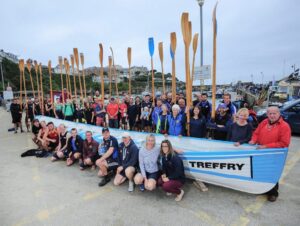
Newquay Rowing Club’s gig Treffry. Gig Rower.
Gigs as Lifeboats
Gigs had a long history of being used as lifeboats and for salvage. One of the earliest records is of Isles of Scilly gigs rescuing the crew of the Royal Navy’s Royal Oak, a 100 gun first rate vessel which foundered on Bishop Rock in 1666. Although the first specifically designed lifeboat by Henry Greathead was launched at South Shields in 1789 many coastal communities used their working gigs to carry out rescues as their qualities of speed, strength and manoeuvrability were tantamount in difficult sea conditions but often rescues posed many difficulties and dangers for the rescuers.
In 1828 William Broad, a well-known ship agent and merchant in Falmouth carried out a rescue of the eleven crew and three passengers of the Larch a 150 ton brig sailing from Newfoundland to Poole in Dorset. In extreme January weather the brig was forced to run for haven in Falmouth but was driven towards the headland of Trefusis and the New Quay in Flushing opposite Falmouth. William saw their distress signal from the opposite shore and with a harbour pilot rowed an open gig across the harbour and worked tirelessly to save the ship throughout the stormy day and following night until eventually with more help the crew and passengers were all saved. For his part in the rescue William was awarded the Gold Medal of the Royal Institution for Preservation of Life from Shipwreck, the forerunner of the RNLI.
In 1871 the Bryher gig Albion could not launch from the islands western shore to assist the steamship SS Delaware. The crew then carried the half tonne gig overland, launched and rowed to neighbouring Samson. They carried the gig overland again before launching and approaching the ship to rescue passengers.
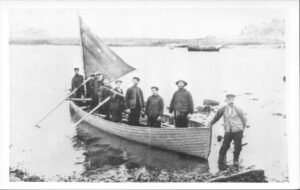
Crew of St Agnes IOS gig Slippen after the rescue of survivors from the Thomas W Lawson 1907. Isles of Scilly Museum.
Motorised lifeboats eventually rendered gigs obsolete for rescues although the final lifeboat rescue by a gig was by the gig Sussex from Bryher which assisted the stranded Panamanian ship Mando in 1955.
Gigs and Smuggling
The very features which made gigs so adept at ferrying goods and persons to sailing ships at sea also made them ideal for smuggling allowing smugglers to outrun heavier customs vessels, to land in areas of the coast inaccessible to such vessels and to carry considerable amounts of contraband cargo. The imposition of government taxation on imported goods in the seventeenth and eighteenth centuries such as tea, spirits (brandy, gin and rum), wine tobacco, lace and silk led to the escalation of smuggling, especially along the southern coasts of England in areas such as Sussex and Kent and also in the more remote areas in the South West especially in Cornwall and the Isles of Scilly where control was more difficult to impose.
A vast underground economy developed in the county and it is said that half the brandy drunk in Britain in the seventeenth and eighteenth centuries was smuggled in through Cornwall and the Isles of Scilly. The temptation and the ability to make profit by avoiding (and outwitting) the Excise became an established feature of life for all levels of society. Smuggling or ‘free trade’ was often operated not only by the poor but by many with maritime backgrounds with the skills and strengths required for sailing and rowing and often alongside legitimate trading and business.
The Reverend Richard Dodge of Talland landed contraband on the beach below his church on the south coast of Cornwall. Zephaniah Job of Polperro, originally a schoolmaster, established himself as the ‘Smugglers’ Banker’ financing smuggling enterprises and becoming rich in the process. In the Penzance area the Carter bothers of Prussia Cove established themselves as a major smuggling gang and defended their territory against the Revenue Service with a gun battery. Isles of Scilly gigs were used in many smuggling sorties. In 1828 the Bryher Gig Venus and the St Marys gig Jolly were both confined to port by the Preventative Service whilst in the 1830s the Bonnet, built by the Peters Family in St Mawes, was said to have made at least twenty-five trips to Roscoff (for contraband) under the command of John Nance, a Scillies pilot.
The heyday of smuggling ended in the 1840s, however when the government introduced free trade with the Act of 1842 which reduced the heavy tax burden on imported goods and smuggled free trade goods were no longer in demand.
The Sport of Gig Racing
The sport of gig racing grew out of the competition between pilot gigs being rowed at speed to be the first to reach a ship with a pilot or ship agent or to supply goods. When a new gig was built it would be trialled against others for performance especially for speed and these trials naturally led to a more competitive format. Gig racing began in the 1830s and the sport grew in the following decades with working crews representing their local areas in competitions. Contests and regattas became a regular feature of river and coastal locations, which were lucrative for the crews and provided popular spectator sport.
In Cornwall and the Isles of Scilly there were regular festival in ports, harbours and estuaries including Truro Royal Regatta, Penzance, Newquay, Fowey, Saltash and Plymouth. In 1857 the Royal Cornwall Gazette recorded that at the Newquay Regatta in a race over a seven-mile course the first, second and third places went to Treffry of Newquay, Circe of Truro and Dove also of Newquay.
Crews competed for a purse of prize money which by the 1850s could vary from a single prize of £12 for a boat to be shared amongst the crew to monetary prizes tiered to first, second and third places of £5, £3 and £2. Six and four oared gig racing was ‘free for all England’ or ‘open to all the world’ and both male and female crews could compete. In 1836 the West Briton reported the prowess of the “Amazon Rowers of Saltash” at the Falmouth Regatta.
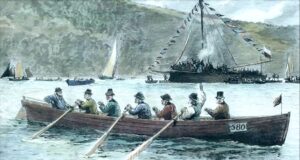
Gig racing in an early regatta
The Amazon Rowers
These female rowers from Saltash earned success in an era when there was very little female competitive sport and were led by Ann Glanville, who had a reputation of being the “champion female rower of the world” and always pulled the stroke oar. Ann had been born in Saltash in 1796, growing up before the railway in what had then been a centre for water carriage between Plymouth and Cornwall and along the River Tamar. She had married a waterman and together they had established a trade which Ann had to take over as the sole trader to support the family when her husband was disabled by illness. She became known for her energy, strength and endurance and later harnessed that ability in professional sport.
The female rowing team rowed four-oared gigs professionally for prize money from the early 1830s until about the early 1850s wearing a sporting uniform of distinctive white short ‘nightdresses’, white caps and ribands. They travelled widely all over the country and sometimes abroad, competing in contests and regattas and attracting considerable popular attention and gaining success in racing.
In 1842 the committee of the Le Havre Regatta in France offered a prize for rowing racing in the regatta. The female team, having recently defeated a male team at Portsmouth Regatta, entered for the stakes and travelled to Le Havre via Plymouth and Southampton on board the Grand Turk. However on arrival in France they were refused entry to competition on the grounds of that it would be an uneven contest of amateurs and professionals. The English press however hazarded the opinion that the real reason was that “The Frenchmen, we presume like the Portsmouth heroes not willing to risk defeat by women, and above all English women, declined the proposed encounter.” Nevertheless the Saltash Amazons raced against a male boat crew from Grand Turk and won.
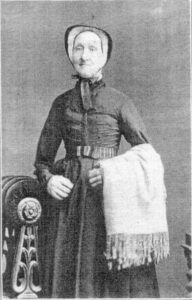
Ann Glanville 1796-1880. Saltash History and Heritage.
Decline and Revival
The use of wooden rowing gigs declined with the growth of steam power for ships and boats. As a result the role of the gig declined in a working capacity together with the sport of gig racing in the twentieth century and many of the old gigs were left to rot. It was kept alive in some communities in the Isles of Scilly and others in Cornwall such as Newquay when the Rowing Club, founded in 1921, purchased and restored their three gigs but it had largely died out by the 1930s.
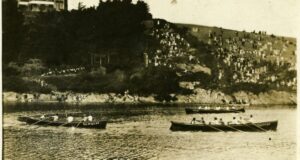
Newquay Rowing Club racing its three gigs in 1922. Photograph donated by John Bawden, showing a gig in Newquay in the 1920s. Pulling Together The Past Archive CPGA.
Interest in gigs and their design continued amongst some boat builders and rowing clubs in into the second half of the twentieth century and Ralph Bird, a boat builder from Devoran on the River Fal, was active in preserving gigs and gig racing. In 1981 Ralph persuaded Newquay Rowing Club to lend him their three gigs for a race on the Fal which revived interest in the sport and led to Ralph and a group of fellow enthusiasts forming the Cornish Pilot Gig Association (CPGA) in 1987. The basis of sporting gigs was agreed as being based on the dimensions of William Peters’ Treffry and in the following years the CPGA has become the governing body for the sport. Ralph Bird, a mainstay of CPGA and the builder of twenty nine gigs before his death in 2009 established a legacy for other builders to build and restore gigs.
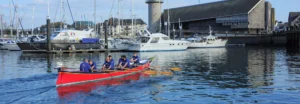
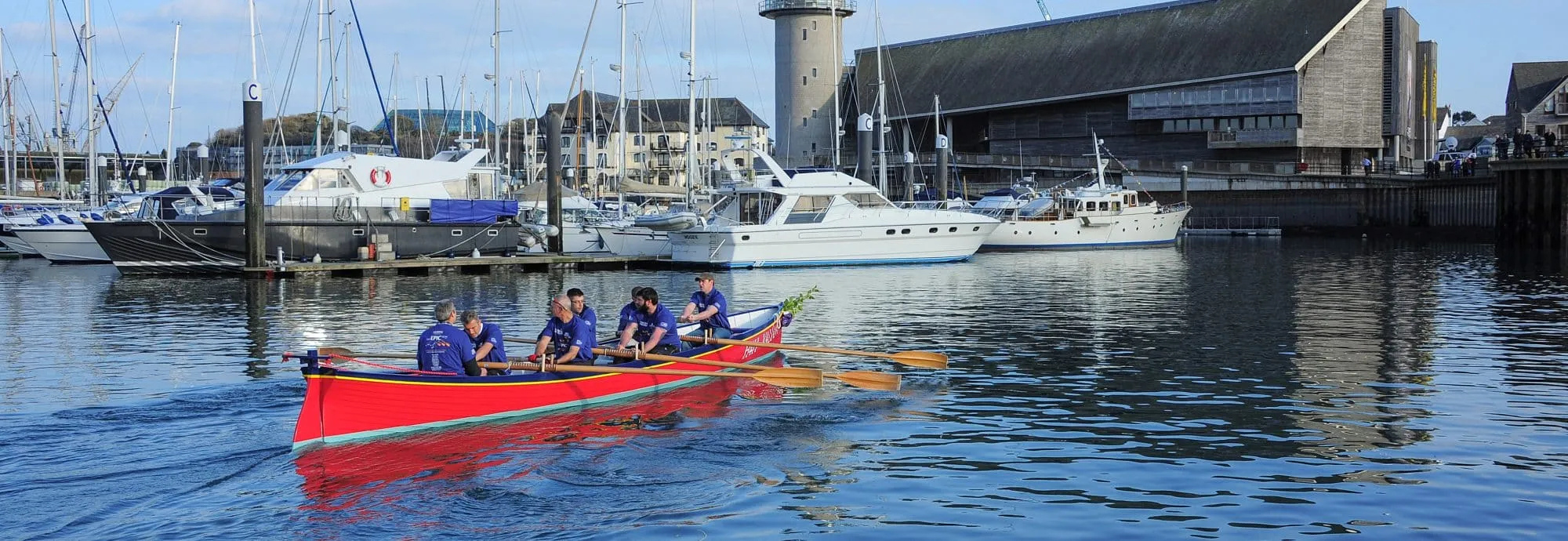
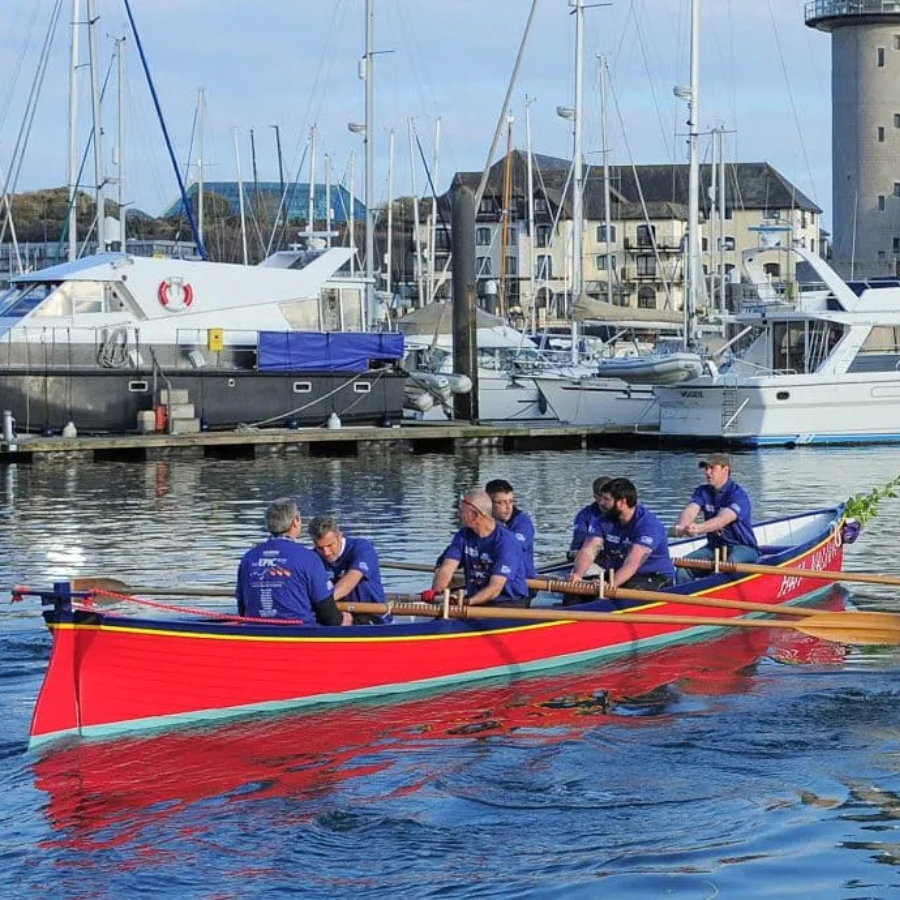
H4H Valiant Military Veterans’ Gig built at National Maritime Museum Cornwall 2016 NMMC.
In 2025 over two hundred and forty gigs have been passed and recorded by the Association and the gig community includes crews from a wider compass than Cornwall and the Isles of Scilly alone. Gigs may bear the name of historic restored survivors whilst the names of others have local significance or commemorate figures in the history of gig rowing. Bonnet, Slippen and Eagle are heritage gigs originally built for islands in Scilly and now back in the islands. Two of Falmouth’s gigs are named after local features Black Rock and Greenbank and in 2016 the gig H4H Valiant was constructed in the NMMC workshop. The Ann Glanville is rowed by the Caradon Gig Club of Saltash, the William Peters by the Roseland Gig Rowing Club both in Cornwall and the Ralph Bird by Porthgain Rowing Club in Wales.
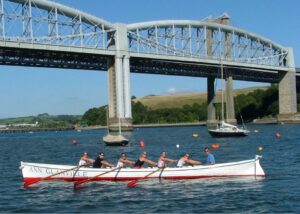
The Gig Ann Glanville. Caradon Gig Club.
The once neglected sport of gig rowing has flourished and grown and now culminates annually in the World Gig Racing Championships each May on the Isles of Scilly.
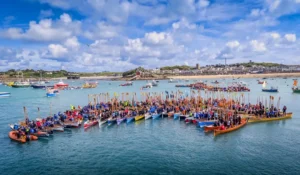
Pilot Gig Championships. (c) Mike Palmer
For Further Reference
Maritime Views: Smuggling and Wrecking
Bartlett Blog: For Those in Peril on the Sea
Bartlett Blog: Maritime Pilots and Pilotage
Slippen Image Research by Lynne Vosper
Cornwall Pilot Gig Association Website (CPGA)
Azook! Pilot Gigs Keith Harris (1994) ISBN 185022075 1
The Bartlett Blog is researched, written and produced by volunteers who staff The Bartlett Maritime Research Centre and Library of National Maritime Museum Cornwall. This blog post was written by Linda Batchelor, a Bartlett Library volunteer.
The Bartlett Maritime Research Centre & Library holds a Collection of over 20,000 volumes and offers access to one of the finest collections of maritime reference books, periodicals and archival material. The Bartlett Blog reflects the diversity of material available in The Bartlett Library.

National Maritime
Museum Cornwall Trust
Discovery Quay
Falmouth Cornwall
TR11 3QY
View Map
See our opening hours
Tel: +44(0)1326 313388
Email: enquiries@nmmc.co.uk