By Linda Batchelor
Lieutenant-General Watkin Tench (1758-1833) has appeared briefly in a previous Bartlett Blog but following more lines of related research now warrants a fuller examination of his contribution to the maritime scene.
An officer in His Majesty’s Marine Forces since 1776 he saw action in various conflicts, was taken as a prisoner of war twice, sailed with the First Fleet, was the author of two accounts of the first colonial and penal settlement in Australia exploring the surrounding territory and eventually retiring from the Marines to become a well-known member of Penzance society.
Watkin Tench was born in Chester in 1758, the son of Margaret and Fisher Tench. Fisher was the son of a Cheshire merchant and after time spent as a Dancing Master in London theatres such as Drury Lane had returned to Chester with his wife had set up a dancing academy and became the proprietor of a reputable boarding school for young ladies. He was an established figure in Chester society. Watkin was one of two sons, the only surviving children of Fisher and Margaret, and grew up with strong cultural and social influences throughout his childhood. His family background led to him receiving a good level of education giving him a broad knowledge and the ability to put that to literary use. His later writings show a command of language, a knowledge of classical and English literature and the influence of the ideas of the enlightenment and rationalism. He also proved as a prisoner of war to be a good speaker of French. He had an interest in science with a keen sense of enquiry and observation. He took with him to Australia the latest example of a Fahrenheit thermometer and whilst there kept a meteorological diary taking readings four times daily. As a Marine officer he showed a sense of duty and loyalty to those he served with and under his command and an appreciation of the rule of law.
The Marines
In 1776 aged seventeen Watkin joined His Majesty’s Marine Forces, Plymouth Division, as a Second Lieutenant. The marines had their origin in the Duke of York and Albany’s Maritime Regiment of Foot established by Charles II in 1664. By 1755 this became a permanent Corps of five thousand marines, grouped into fifty companies of three divisions based in Chatham, Plymouth and Portsmouth and in 1802 the Corps became the Royal Marines.
The Marines were the naval infantry force controlled by the Admiralty providing security for ships, maintaining discipline on board and in naval incidents and battles engaging the enemy. Commissions for marines were awarded directly from civilian life by the Admiralty usually through political patronage or social connections and this is probably the way in which Watkin secured his commission. There was sometimes a contemporary view amongst army and naval officers that marine officers were somewhat inferior as they were drawn largely from the middle rather than the gentlemen class. This view was also compounded by the facts that most army commissions were purchased and most naval appointments came through service and examinations often from a young age as a Captain’s Servant or Midshipman whereas marine officers could be appointed directly from civilian life.
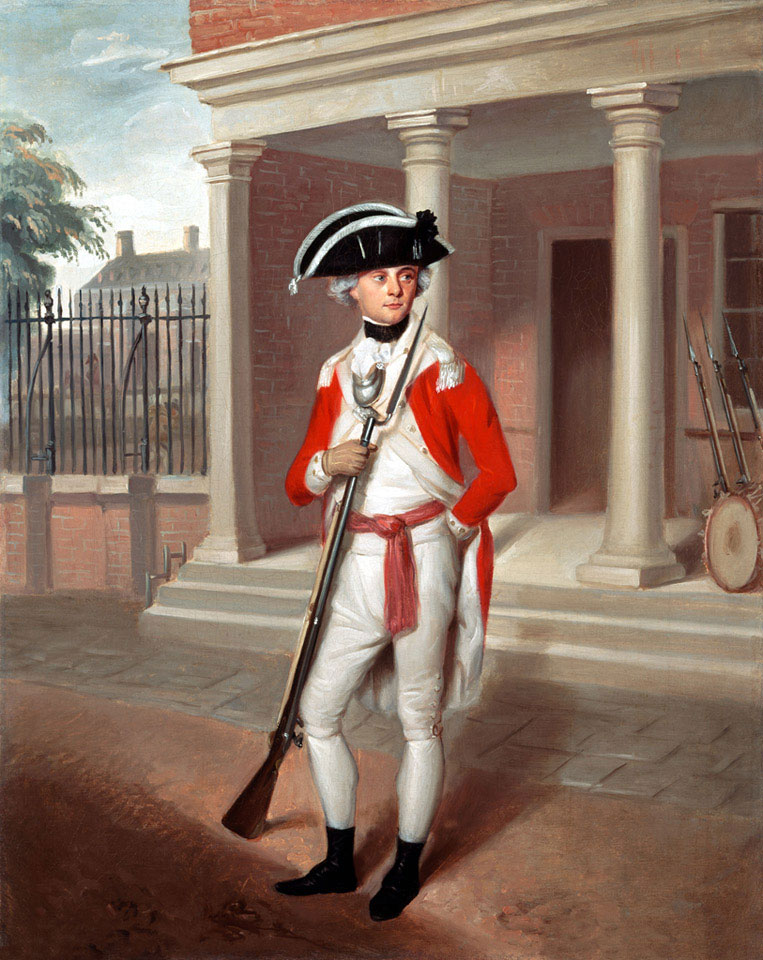
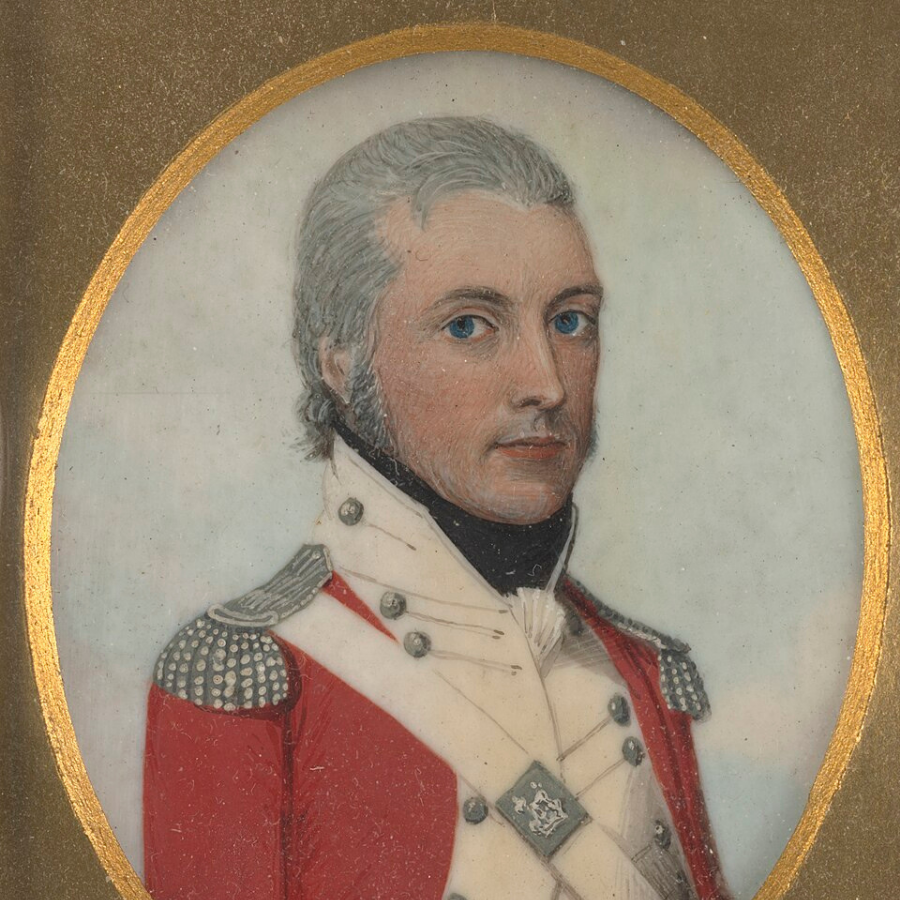
In the eighteenth and early nineteen century marine uniforms were similar to the dress of infantry regiments of the British army. When on duty or in action marines wore red coats with white facings for lapels, cuffs and linings. They wore white cross belts and breeches and black bicorn hats. Officers uniforms were of finer materials with more embellishment depending on rank and with a gilt metal or silver plate, a gorget, worn at the neck. Watkin recalled that when captured at sea during the French wars despite surrendering his sword to a French naval officer he was also forced to give up his cross belt for the attached silver gorget. Marines were armed with the ‘Brown Bess’ musket and bayonet. Officers supplied their own swords and small arms.
Prisoner of War
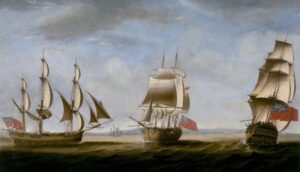
Shortly before Watkin joined the Marines the War of American Independence had broken out between the American colonies and Britain in 1775. Watkin was assigned to posts on British naval warships such as HMS Nonsuch, HMS Mermaid and HMS Unicorn. In January 1778 he was promoted to Lieutenant and was in command of Marines on board HMS Mermaid when the ship was run aground on Assateague Island off the North American coast in July 1778. Mermaid, a frigate of twenty-eight guns under the command of Captain James Hawker, had been patrolling the waters of Nova Scotia and the coast of Maryland and Delaware when she was intercepted by a French fleet under Count D’Estaing which had been sent to assist the American colonies against the British. Pursued by the fifty-gun Sagittaire and the sixty-four gun Fantasque, to escape from being taken as a prize by the French Captain Hawker beached the ship near Cape Henlopen, Delaware and ordered her destruction and surrendered the ships’ complement to the American forces.
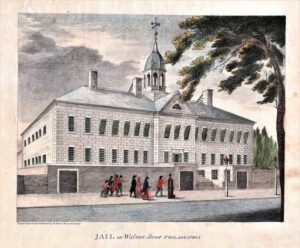
Watkin, his detachment of marines and the crew of sailors were taken prisoners and transported to Philadelphia, which was in the hands of the Americans, where they were held as prisoners of war in Walnut Street Jail.
After an exchange of prisoners Watkin was moved to New York and later resumed his service on HMS Unicorn and returned to England at the end of 1779. He then served in HMS Grafton and HMS Diadem during which time in 1782 he was promoted to Captain-Lieutenant. The war ended in 1783 with independence for the American colonies.
The First Fleet
With the war over, in May 1786, Watkin was put like many other officers in peacetime on half pay until he joined a new marine unit formed in August 1786, the New South Wales Marines, to accompany the First Fleet taking convicts to establish the new penal colony and settlement in Australia. An incentive of two guineas was offered to encourage men to join the new unit and whereas marines were usually enlisted for life, members of the unit could leave with an honourable discharge after a three year tour of duty. The battalion sized corps of 160 marines and 52 officers and non-commissioned officers was under the command of Major Robert Ross. Watkin was one of the two Captain-Lieutenants in the unit.
In 1770 Lieutenant James Cook, Captain of the crew of HMB Endeavour, had been the first Europeans to chart the East coast of Australia and had claimed “the whole of the eastern coast down to this place by the Name of New South Wales together with all the Bays, Harbours, Rivers and Islands situate upon such coast” for Britain. Over a decade later Lord Sydney, the Secretary of State for the Home Office, had decided to establish a penal colony and settlement in the Australian territory for two purposes, to challenge French expansion in the Pacific and to provide an outlet for the transportation of convicts and in 1785 it was to this coast and the territory of New South Wales that the British Government announced that convicts sentenced to transportation would be sent in the future.
Captain Arthur Phillip RN was appointed by Lord Sydney in September 1786 to command the First Fleet to Botany Bay, to set up the penal colony and to become its first Governor on arrival in New South Wales. A subsidiary settlement was also to be founded on Norfolk Island.
A fleet of eleven ships were assembled to take over 775 convicts, male and female and over 645 free persons, made up government officials and administrators, marines and their families and naval crews into the largely unknown territory on the other side of the world. Not only would the fleet need to accommodate the numbers involved but would need provisions for the lengthy voyage together with the means of immediate survival on arrival.
Two of the ships HMS Sirius and HMS Supply were from the Royal Navy and the other nine were chartered merchantmen. There were six convict transports each with a detachment of marines, the Alexander, Prince of Wales, Lady Penryn, Scarborough, Friendship and Charlotte. The rest of the Fleet was made up of three supply ships, Borrowdale, Fishburn and Golden Grove. The convoy sailed from the Motherbank off Spithead on 31 May 1787.
Captain-Lieutenant Watkin Tench sailed on board the transport Charlotte in command of a detachment of forty-two marines who were to guard the convicts on board and on arrival in Australia were as he later wrote “for the protection of the settlement intended to be made there, as well as for preserving good order and regularity among the convicts”
The Charlotte was a 350-ton barque originally built for trade with the Baltic but in 1786 the vessel was hired by the British government from the owners Matthews & Co of London as one of the six convict transport ships to Australia. Charlotte was captained by Thomas Gilbert with a crew of 30. Alongside Captain-Lieutenant Tench and his detachment of 42 marines, plus surgeon John White designated to be Surgeon General of the Colony, there were 88 male and 20 female convicts aboard.
The voyage was arduous and long, sailing first to Tenerife in the Canary Islands and Rio De Janeiro in South America before crossing to Cape Town in South Africa. The Fleet then embarked on the final part of the voyage of two months across the Indian Ocean and reached the coast of Australia in mid January 1788 and all the vessels were in Botany Bay by January 20. Although the Bay had been advocated as the place for the penal colony Captain Arthur Phillip deemed it unsuitable and took an exploratory party in three small boats along the coast and found a site approximately seven miles to the north, a ria or natural harbour of the Tasman Sea with excellent anchorage, fresh water and fertile soil. Captain Phillip named this as Sydney Cove, decided this was the site for the penal colony of Port Jackson and the Fleet sailed there.
The Early Settlement
An advanced party of officials, marines and a contingent of convicts went ashore on January 26 and 27 and the male convicts were disembarked from January 28 followed by livestock and supplies. Female convicts and their children were not landed until February 6.
By then areas had been identified for civilian, military and convict encampments and the work of building the settlement. Tents and rudimentary shelters were erected together with the Governor’s portable house, timber was felled and some ground cleared. On February 7 there was a formal proclamation of the colony under the governorship of Captain Phillip in a newly constructed assembly ground before all those who had arrived with the First Fleet. The convicts although guarded by the marines were not confined or shackled.
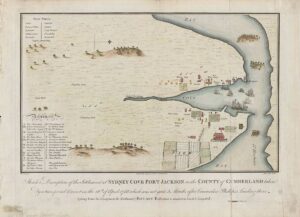
The work of building the settlement and its infrastructure went ahead rapidly with the hard work of convict working parties. Convicts were originally housed in tented camps for men and women and later huts were constructed to the north of the inlet known as the Tank Stream. Hospital tents were some of the first constructed here. Marine barracks and a parade ground were also in this vicinity and marquees were erected to house officers such as Watkin. The Governor’s ‘mansion’ and the living accommodation for other officials were all to the south side of the stream. The settlement also soon included store houses, saw pits, a smithy, brick fields and an observatory.
A sketch map drawn by Francis Fowkes, a convict, in April 1788 showing the development of the settlement three months after the Fleet landing. It shows the position of the Governor’s House, the military encampment, the convict tents and the growing infrastructure of the settlement.
Although the basic requirements of the settlement were quickly in place the early months and years were in the words of the Judge Advocate David Collins “years of famine, toil and difficulty”. Watkin kept a journal in which he recorded details of these difficult years but always displaying a philosophical and sympathetic approach to those around him. The Marine Commander Major Ross was a man with an uncertain temperament and the result was friction within the Corps and with the Governor and other officials. Despite the difficulties Watkin was loyal to Corps principles, had a care for the men under his command and formed good relationships with many of his fellow officers and officials.
Watkin kept a daily journal and was an intelligent observer and collector of information. He spent time with Lieutenant William Dawes, an engineer and surveyor and a competent astronomer, tasked by the Astronomer Royal with collecting astronomical data and who by early June had built an observatory in Port Jackson. Watkin kept a meteorological diary taking readings at a shaded spot four times daily. From June 1789 Watkin commanded an outpost at Rose Hill (later Paramatta) and took part in exploring the surrounding country inland to the west of Sydney. After a three day expedition accompanied by Lieutenant Dawes they ‘discovered’ at the foot of the Blue Mountains a river named by Watkin the Nepean River. Later it was realised that it was a tributary of the Hawkesbury River which flowed into Sydney Bay.
Two Published Accounts
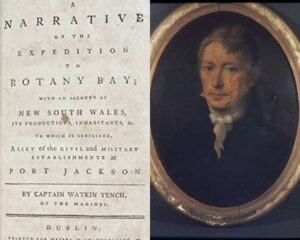
Watkin produced two accounts of his time with the First Fleet and the settlement of Port Jackson which The Australian Dictionary of Biography has described as “First to mould Australian experience into a work of conscious art”. The initial account, ‘A Narrative of the Expedition to Botany Bay’ was written during the first six months in Port Jackson, was sent back to England on the Alexander and was published in London in 1789 whilst Watkin was still in the colony. The second ‘A Complete Account of the Settlement of Port Jackson’ was published in 1793 after Watkin returned to England the previous year. Both were extremely popular and as well as the English editions there was an Irish edition and translations in Dutch, French, Swedish and German.
There was considerable contemporary public interest in the concept of the expedition and establishment of the colony in Australia, and it appears that several publishers were keen to secure contracts for subsequent accounts. Watkin was contracted by publisher John Debrett but other publishers also approached and contracted other members of the expedition. Several accounts were also published including one by Governor Arthur Phillip, some by Watkin’s fellow officers in the marines such as David Collins, others by naval officers and one by James Martin transported as a convict. Watkin’s was however the first to be released and was probably the most popular at the time. It is still well regarded and assessed today by the State Library of New South Wales as “engaging and easy to read. He provides entertaining accounts of daily activities in the colony, often sympathetic observations of various events, convict life and the nature and status of the indigenous people.”
In 1791 Watkin’s tour of duty was over and he choose to return to England sailing on HMS Gorgon arriving in Plymouth in 1792. The same year he married Anna Maria Sargent the daughter of a Devonport surgeon and returned to serve in the Plymouth Division of Marines.
A Prisoner of War for a Second Time
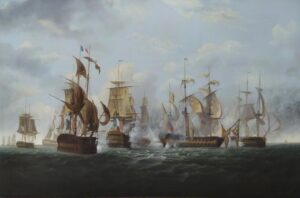
Once again Britain was at war with France following the upheaval of the French Revolution. Watkin was promoted to Brevet Major and joined HMS Alexander under its captain Admiral Richard Rodney Bligh. The ship was part of the Channel and Mediterranean fleet patrolling and blockading the French coast and escorting convoys of ships through the Mediterranean. HMS Alexander and HMS Canada, both seventy-four gun warships, were returning homeward in November 1794 after escorting a convoy to Cape Saint Vincent when they were intercepted two hundred miles west of Ushant by ships of the French Navy. The squadron of five warships, three frigates and a corvette commanded by Rear Admiral Joseph Marie Nielly were under orders to harass and engage with the enemy. Pursued by the far superior enemy Bligh was forced into surrendering the Alexander as a prize allowing the Canada to escape and the Alexander’s crew to be taken prisoners.
Watkin was to recall the capture and the following period of detention by “the insolent foe” in a series of letters to a friend in London published on his return to England six months later. At the time of the capture the French navy was under the control of the Revolutionary Government after the fall of Robespierre. Watkin and the crew of the Alexander were initially taken on board the French warship Le Marat and sent to Brest. His letters talk of the perfunctory surrender procedures, being stripped of their belongings and being confined as prisoners. He is critical of French naval discipline and customs and the “gross and polluted state” of French vessels and particularly conditions in the prison ship Normandie where they were transferred two days after capture.
Later however after Admiral Bligh obtained permission to have Watkin with his command of French as his aid-de-camp and interpreter he was sent with the Admiral on parole to Quimper where he was lodged in private houses and allowed the freedom to roam within a three mile radius of the town. This concession allowed him to observe and comment on the political and social effects of the revolution in his letters. He was returned home to Plymouth in a prisoner exchange in May 1795 and continued to serve on active service aboard several ships until 1802. From that time on until in 1815 he had shore posts in Chatham, Woolwich and Plymouth, retiring as a Major General. In 1819 he was recalled to serve as Commandant of the Plymouth division until retiring in 1827.
In Penzance
Watkin, his wife and adopted family lived in Penzance from 1818 until 1828 in what for many years was regarded as the best street in the town. They lived in an imposing town house in Chapel Street which had originally been built in the 1700s by Richard Oxnam a leading Penzance merchant. The house, now divided and known as Mincarlo and Scranton House, was large, built of brick, unusual in Cornwall, and with a garden behind which ran down to the waterfront.
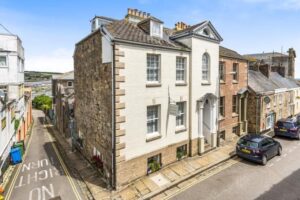
Mincarlo and Scranton House Chapel Street Penzance, once a single house occupied by Watkin Tench.
Watkin and Anna Maria had no children but in 1821 took on the orphaned family of three nephews and a niece on the death of Anna Maria’s sister, Sarah, widow of Captain John Bedford RN. This was clearly an affectionate and loving relationship as witnessed by family letters and papers and in a plaque in the local church dedicated by the three brothers to their sister who died young and “intended to commemorate the adoption and constant care towards an orphan family by an affectionate uncle and aunt.”
The family became established in the town, with Watkin becoming a distinguished and well-known figure. The three nephews all served as officers in the Royal Navy. Two married daughters of the Bolitho family of Penzance and eventually retired from the Navy to take up positions in the family banking businesses. The third became a Gentleman Usher and Secretary to Queen Adelaide.
Watkin continued to maintain a wide and enquiring approach in his outlook with interests in several fields. He joined and chaired local societies for geology, natural history and for antiquarians. There was also the Penzance Library, founded as a subscription library in 1818 combining an earlier ladies book club which had been followed by one for gentlemen. By 1820 there were over a hundred members and Watkin kept his literary interests alive by serving as President from 1821. In Watkin’s day the Library occupied various venues in Penzance but it continued to grow until in 1889 it became the Morrab Library when it moved to Morrab House where it is still situated. It now holds over 60,000 books and an extensive archive.
Watkin and Anna Maria relocated to Devonport when he retired from the Marines as a Lieutenant-General in 1828 and Watkin died there in 1833.
Watkin Tench was in many ways a conventional product of his time. A career officer in military service following the conventions of the Corps of Marines in which he served and with a sense of duty and loyalty. On the other hand he was influenced by a somewhat unusual social and cultural background and by the ideas of the enlightenment. This led to a level of curiosity giving rise to a variety of interests which, coupled with good observational powers and literary ability, enabled him to produce entertaining and interesting commentary on some of the major developments of the era especially as a published chronicler of the first European settlement in Australia in 1788.
Further Reading
Bartlett Blog: Transported to New South Wales
A Narrative of the Expedition to Botany Bay Volume 1 Published 1789. Watkin Tench. An account of the voyage and arrival of the First Fleet.
A Complete Account of the Settlement at Port Jackson Volume 2 Published 1793. Watkin Tench. An account of the early years of the Settlement.
Letters Written in France to a Friend in London Published 1796 Watkin Tench.
The Bartlett Blog is researched, written and produced by volunteers who staff The Bartlett Maritime Research Centre and Library of National Maritime Museum Cornwall. This blog post was written by Linda Batchelor, a Bartlett Library volunteer.
The Bartlett Maritime Research Centre & Library holds a Collection of over 20,000 volumes and offers access to one of the finest collections of maritime reference books, periodicals and archival material. The Bartlett Blog reflects the diversity of material available in The Bartlett Library.

National Maritime
Museum Cornwall Trust
Discovery Quay
Falmouth Cornwall
TR11 3QY
View Map
See our opening hours
Tel: +44(0)1326 313388
Email: enquiries@nmmc.co.uk