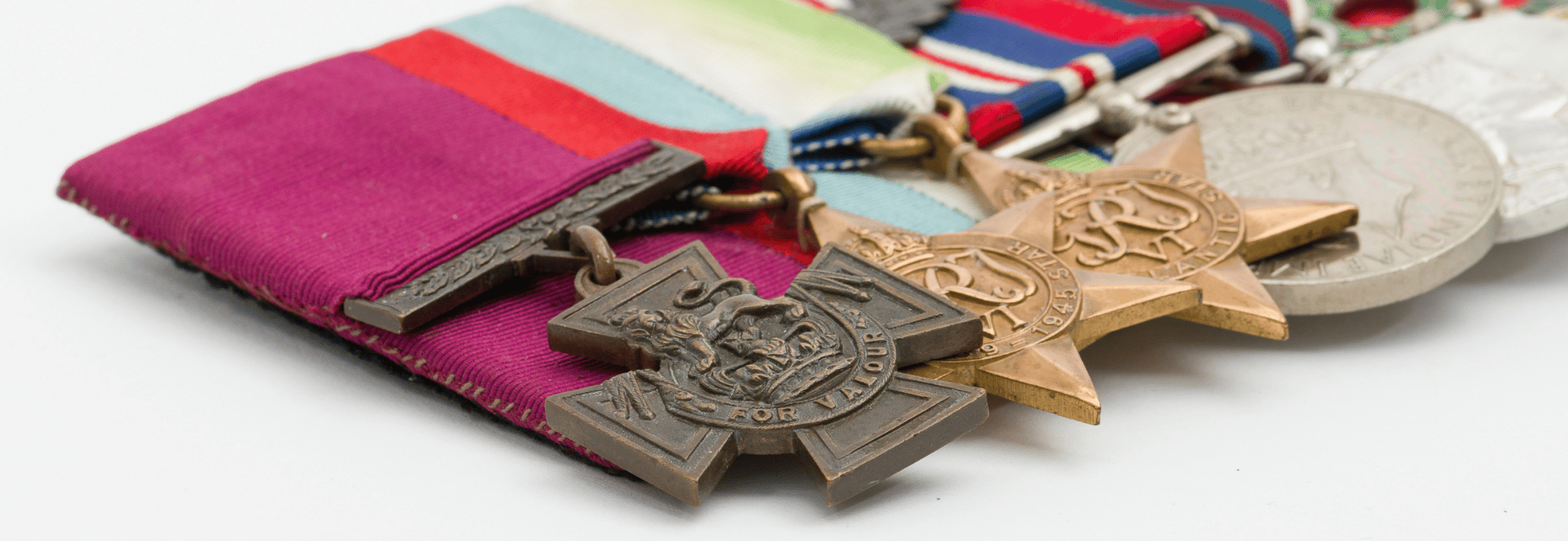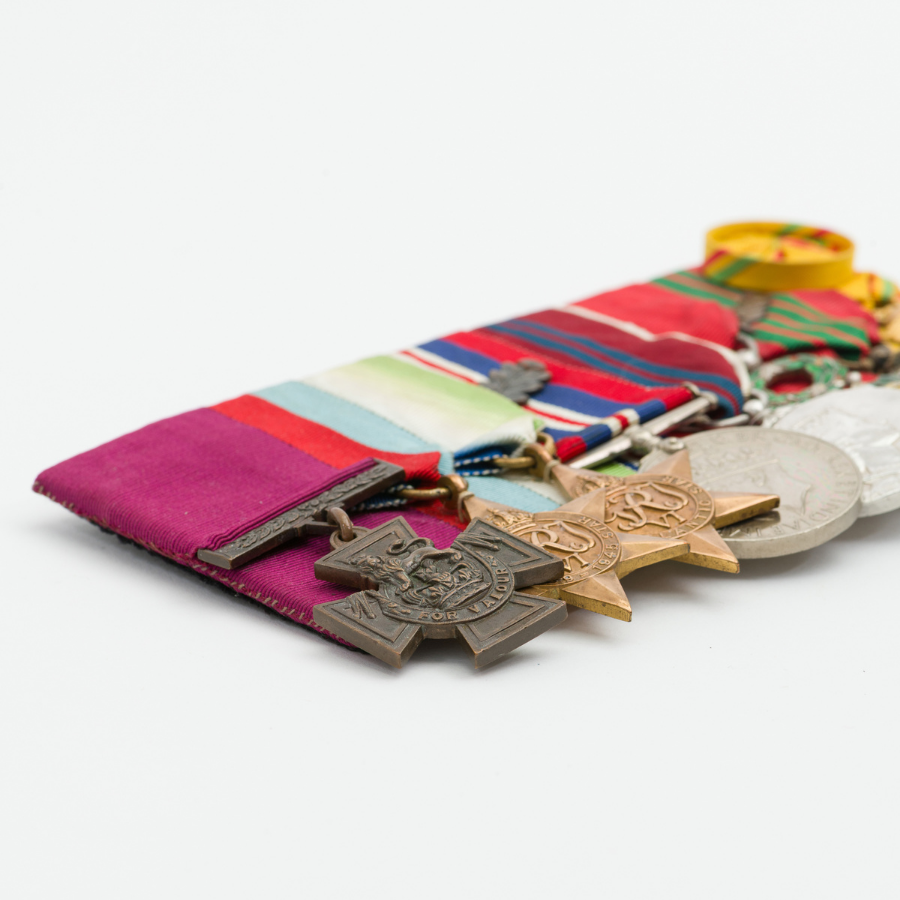
This post draws on content originally researched, written and published by Lynne Vosper, Bartlett Library & Maritime Research Centre Volunteer: Falmouth Harbours Monuments and Memorials – Part 1
The Strategic Seed of a Daring Plan
The origins of one of the Second World War’s most daring missions can be traced to one strategic realisation:
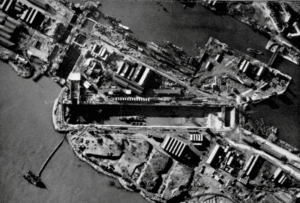
‘In July 1941, when it was realised that if the powerful German battleship Tirpitz could be prevented from dry-docking on the western Atlantic coast, she would have to return to her home ports, the seed was sown to destroy the Normandie Dock at St Nazaire, the only graving dock large enough to take the ship.’
Planning intensified through late 1941 and into early 1942 when Admiral Mountbatten became Chief of Combined Operations final plans were drawn up for what became known as ‘The Greatest Raid of All’.
HMS Campbeltown: A Ship Transformed
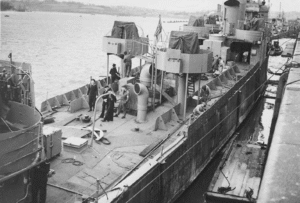
The vessel chosen to spearhead the mission had an unlikely origin. An ageing, surplus American destroyer ex-DD131 USS Buchanan was selected and renamed HMS Campbeltown. Prior to arrival in Falmouth, the ship underwent significant modifications at Devonport Dockyard, to mimic the profile of a German Wolf Class destroyer, enabling her to fly German colours on the approach to the target.
‘HMS Campbeltown arrived in Falmouth on 23 March 1942 with two ‘Hunt’ class destroyers that were to act as escort ships, helping to protect the raiding party as they made their way to St Nazaire.’
The Flotilla Departs
The scale of the operation was extraordinary. On the afternoon of 26 March 1942, over 600 men left Falmouth aboard a flotilla comprising 16 motor launches (ML), one motor gun boat (MGB), one motor torpedo boat (MTB), two escorting destroyers and HMS Campbeltown, loaded with five tonnes of high explosives and 24 depth charges.
Their objective was the dock complex at St Nazaire, a port town on the northern bank of the Loire estuary. Destroying it would deny the Tirpitz a vital Atlantic base from which to threaten Allied shipping lanes.
The Raid Itself
In the early hours of 28 March 1942, the plan was executed with devastating effect. Commando forces stormed ashore and set about demolishing dock infrastructure with precision. HMS Campbeltown, travelling at 20 knots, rammed directly into the gates of the Normandie Dock. The delayed explosion that followed rendered the port inoperable for the remainder of the war, a goal that was achieved at enormous human cost.
The price paid by those who took part was severe. Of the 611 men who set out, only 228 returned home. Some 169 men lost their lives and 215 were taken prisoner. Of the 18 motor launches that departed Falmouth, only four made it back.
Honours Awarded
The bravery displayed during Operation Chariot was recognised with a remarkable number of decorations, including five Victoria Crosses:
Falmouth’s Lasting Connection
The link between Falmouth and the St Nazaire Raid endures to this day. The National Maritime Museum Cornwall holds a dedicated display of artefacts connected to Lieutenant Commander Beattie and the raid and members of the St Nazaire Society return to Falmouth annually to mark the anniversary of this remarkable operation.
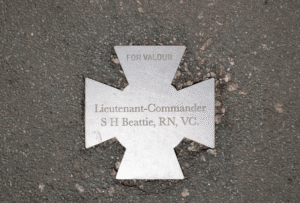
For more about Falmouth’s marking of the St Nazaire Raid, see Falmouth Harbours Monuments and Memorials – Part 1 written by Lynne Vosper, Bartlett Library & Maritime Research Centre Volunteer.
Bring the Beattie Medals Home: Launching 14 September
Captain Stephen (Sam) Beattie’s Victoria Cross and medals awarded for his extraordinary courage during the 1942 St Nazaire Raid, need a secure new home so that his story, and that of the brave crew who fought alongside him, can be shared for generations to come.
On 14 September 2026, we launched a crowdfunding campaign to give these medals the protection they deserve. We’ll need our supporters with us every step of the way, through sharing, donating, and spreading the word. Support the campaign here.

National Maritime
Museum Cornwall Trust
Discovery Quay
Falmouth Cornwall
TR11 3QY
View Map
See our opening hours
Tel: +44(0)1326 313388
Email: enquiries@nmmc.co.uk