By Linda Batchelor
‘Who hath Desired The Sea’ is the title of the Autobiography published in 1962 by Peter Gerard. Born in 1900, by the 1920s Peter had harnessed a love of sailing and was working as a reporter and journalist for the yachting press.
The title of the memoir is taken from a stanza in a poem ‘The Sea and The Hills’ by Rudyard Kipling.
Who hath desired the Sea? – the sight of salt water unbounded –
The heave and halt and the hurl and the crash of the comber wind- hounded?
The poem celebrates the allure of wild untamed spaces especially the connection to the sea and epitomises Peter’s attitude towards sailing and approach to life in general. In an era when yachting and journalism was generally dominated by men it is indicative of how unusual both such occupations were for a female writer at the time. It is not surprising therefore that Peter Gerard was the pseudonym for Dulce Kennard, the epitome of the 1920s woman with her bobbed hair, a confident attitude to life and an unconventional career.
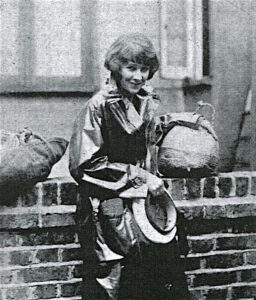
Dulce/Peter ready for sailing.
Dulce Hazel Kennard was born in France in 1900 to Henry Gerard Hegan Kennard and his wife Nancy (Annie). Her father was a professional soldier, an officer in the 5th Dragoon Guards, with postings throughout her childhood and adolescence both at home and abroad such as South Africa, India and Ireland and the family were well travelled. In the 1911 Census the family were recorded as living at the Curragh Military Camp in Kildare in Ireland where by then Henry was a Colonel. Dulce had an elder brother, Terence born in 1896, killed in World War 1, and a younger sister, Tertia born in 1906. At the time of the Census a governess is listed as part of the household but later both Terence and Tertia were pupils at Bedales School the progressive co-educational school in Hampshire. It is not clear, however, whether Dulce was also ever a pupil but it seems probable.
Dulce had been introduced to sailing whilst on holiday in the Isle of Wight and she was captivated by the experience. Before World War 1 there had been considerable resistance to accepting women into many areas of life, including yachting and yacht clubs, but the war had begun to change some attitudes. Dulce was amongst those young women who seized the opportunity to break away from a conventional path aimed at a more independent way of living and began to follow her serious interest and love of sailing. By the 1920s she had harnessed that aim and was working as a reporter and journalist for the yachting press albeit bowing to pressure and writing under the adopted male pen name of Peter Gerard. She was already called Peter by herself and those around her and she added Gerard from one of her father’s middle names.
During this time in the mid-1920s she became acquainted with Maurice Griffiths who was making a name for himself as yachtsman and writer when they were both trying to sell their articles to the yachting press. Maurice recorded that “In London I met a quiet slender girl with dark shingled hair who was writing articles for the yachting papers under the name of Peter Gerard”. Before the First World War there was resistance to accepting women into yachting and yacht clubs and during subsequent years Dulce was a pioneer in establishing the position of women in the yachting world. According to Maurice “Peter was no dingy dolly.” When sailing she was often dressed practically in trousers, sweaters and oilskins and wearing a cap and was “wiry, tough and utterly fearless once afloat.”
Griffiths was born in London in 1902 but was brought up in Ipswich where, as a young man his interest in sailing had developed. He spent time exploring the swatchways, the creeks and rivers of the Thames Estuary and the East Coast. In 1921 he and a friend had bought a semi derelict fifty-year-old cutter Udine to restore in exploring these coastal waterways. As a result of the purchase Maurice started a fledgling yacht brokerage business which went well until the death of his father a few years later leaving the family in financial difficulties forcing him to give up the brokerage. Instead he turned to writing and in 1925 produced a book Yachting on a Small Income which sold well on station bookstalls. A copy was bought by the publisher of Yachting Monthly, George Bittles, who was impressed and offered Maurice the editorship of a new magazine Yacht Sales and Charters.
The friendship between Dulce and Maurice grew and in 1927 The Tatler reported their engagement which was followed by their marriage at the church of St Clement Danes in London. Maurice acquired Afrin a thirty-four-foot pilot cutter and gave Dulce a half share of the ownership. Dulce (Pete) and Maurice (Bungo) lived permanently aboard Afrin moored in the Walton Backwaters, a thirty minute walk or fifteen minute row away from the town of Walton on the Essex coast. The Backwaters were an area of tidal creeks and salt marsh and were the setting for Arthur Ransomes book ‘Secret Water’. Maurice travelled daily by train to the Yachting Monthly magazine offices in London whilst Dulce remained in Walton writing and giving sailing instruction. They both maintained their sailing activities, sometimes they crewed together in races but also individually. Maurice liked to potter about the East Coast creeks while Dulce preferred singlehanded open water sailing.
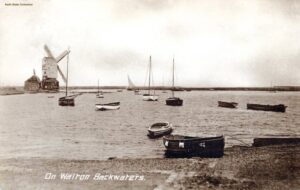
Walton Backwaters circa 1920. Foxearth and District Local History Society
In August 1927 both Dulce and Maurice joined the crew of Irish yachtsman Conor O’Brien’s Saoirse for the Fastnet Race from Cowes to the South West corner of Ireland and back to Plymouth. Dulce was listed as Peter Gerard and she later reported the race under that name in the Fore an’ Aft Magazine. She wrote that the race “was completely marred by bad weather” and that “within five hours after the start practically all boats had lost sight of one another and reminded wrapped in little worlds of their own”. Of the fifteen starters only two rounded the Fastnet Rock and the rest withdrew, including Saoirse.
Juanita
In the year of their marriage Dulce had also bought her yacht Juanita a Falmouth Quay Punt built in 1896. One of the thirty nine quay punts built by Thomas Jackett of Falmouth initially Juanita was a working boat but when purchased by Dulce had been converted for leisure purposes. Dulce described Juanita in her memoir as “my dream ship” which with a tender called Buster became the focus in many of her future ventures.
Quay punts were small sturdily built wooden sailing vessels able to be easily operated alone, working as the runabouts in the port of Falmouth from Custom House Quay to serve the various needs of the large merchant sailing ships which came to “Falmouth for orders”. After World War I as steam and motorboats took over from sail many of these working boats were converted into yachts for more leisure purposes.
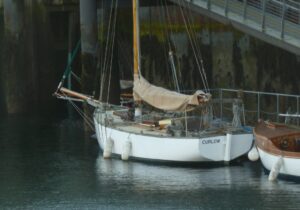
The former Falmouth Quay Punt Curlew, a ‘sister ship’ to Juanita.
Built R S Burt, Falmouth in 1902 as working boat and converted to a leisure craft in 1936. Donated in 2003 to the National Maritime Museum Cornwall by owners Tim and Pauline Carr.
Juanita originally owned by Arthur Davies and then James Deeble in a working capacity was later owned as a yacht from 1924 by Herbert Crowther and had been on the market for some time when Dulce and Maurice met with him to negotiate her sale in London. Dulce “handed over the cheque representing nearly all I had” and became the owner of Juanita, a relationship which lasted until her death in 1980.
Dulce began a yachting training school taking female ‘cadets’ on voyages around the East and South coast of England including the Scillies. In October 1931 an article in The Vote, a suffrage newspaper, described how “for the last two years she has been training women skippers on Juanita”. The article listed the training skills acquired and quoted that Dulce considered “it a paying proposition for yacht owners to employ women, because of their steady application to their duties”.
Divorce
Unhappily despite their mutual interest in sailing, for various reasons Dulce and Maurice grew apart, their marriage did not last, and eventually in the early 1930s they divorced.
Maurice went on to become a major figure in the yachting world who democratised and encouraged the accessibility of boating and sailing. He became editor of Yachting Monthly and continued to write on sailing matters producing many books including the iconic Magic of the Swatchways. He also became me a leading yacht designer and during the second World War was a Lieutenant Commander in the RNVR and in 1942 was awarded the George Cross for ‘gallantry and undaunted devotion to duty’ for his work in defusing mines and bombs. He married Wren Officer Marjorie Copson during the War whilst stationed at HMS Vernon in Portsmouth and afterwards returned as Editor of Yachting Monthly. He remained a keen sailor living on the East Coast until his death in Colchester in 1997.
Marriage to Charles Pears
After her divorce from Maurice, Dulce married as her second husband the marine artist Charles Pears. Dulce and Charles, who was twenty years older than Dulce, had known one another for some time and shared a mutual interest in sailing and yachting journalism. They were both part of the East Coast sailing community and both kept their boats at Heybridge Basin near Malden in Essex. The relationship between Charles who was widowed and Dulce developed further and after her divorce they were married at Kensington Registry Office. Dulce was described in a newspaper report of their marriage as an “expert yachtswoman” and as “an instructress in seamanship.”
Charles had been born in Pontefract in 1873 and was living in London by 1900 with his first wife Miriam. After initially working as a successful commercial artist and illustrator he had established a reputation before the First World War in the fine art world especially as a marine artist. With his expertise as a marine painter he was appointed as the Official War Artist to the Admiralty and was commissioned into the Royal Marines in both World Wars. During his career, in 1939, he was the first elected President of the Royal Society of Marine Artists (RSMA) and he was also a member of The Royal Institute of Painters in Watercolours, the Royal Institute of Oil Painters, the Fine Art Society and the New English Art Club.
Sailing became a passion for Charles and added another dimension to his life and in 1923 he had purchased his yacht Wanderer from the fledgling yacht brokerage of Maurice Griffiths near Ipswich. Although he was involved in various aspects of sailing his interest was in single-handed cruising much of it on the East coast of England. Hole Haven, a creek to the west of Canvey Island on the lower Thames was the starting point for many of his sailing trips and he contributed articles to yachting publications and published several books about his sailing adventures.
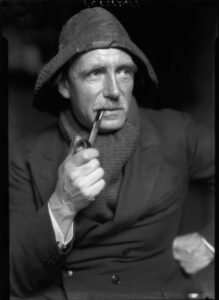
Charles Pears by Howard Coster, half-plate film negative, 1926. Transferred from Central Office of Information, 1974 Photographs Collection NPG x24558.
Marriage to Dulce reinforced his sailing interests and they spent time working or sailing in a variety of locations including London and Heybridge and around the East and South Coast. Charles continued his work as an artist and Dulce ran the sailing school for female cadets which involved taking two or three students sailing from Heybridge along the East and South coasts as far as the Scillies.
Cornwall
By the late 1930s Dulce and Charles were both in Cornwall living on their respective boats on the Percuil River near St Mawes. Initially Charles rented Polvarth Studio in St Mawes, previously a boathouse built by the Lancaster family in 1931, but when at the start of World War II, wartime regulations prevented them living on Juanita and Wanderer they moved into the studio. The boathouse had its own private quay, a slipway and the foreshore offered direct water access. They remained there for many years and became familiar figures in St Mawes where Charles founded the St Mawes Art Club in 1945 for both professional and amateur artists. Dulce wrote her autobiography covering the years up to 1962 Who Hath Desired the Sea.
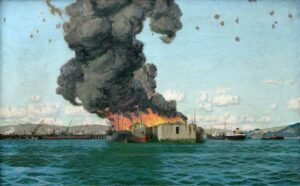
Pears, Charles; The Bombing of ‘The British Chancellor’, 10 July 1940; Falmouth Art Gallery. Presented by A & P Falmouth in October 1993 to Falmouth Art Gallery.
Dulce and Charles were also well known in the sailing community, especially around St Mawes and Falmouth. They both retained their own yachts, Juanita and Wanderer although they did not often sail together. Despite having a friendly rivalry, they were too competitive and did not get along with one another on board and so sailed separately.
Charles died in Truro in 1958 and Dulce remained in St Mawes until her death in 1980.
Dulce’s ‘Dream Ship’
Juanita been kept beside the Studio and by 1980 was in a sorry state. She was rescued and rebuilt by Douggie Burnett and John Green of Freshwater Boatyard and sailed in the Falmouth Working Boat Fleet but was sold in 1985. Juanita changed hands and was returned to the East Coast by subsequent owners and in 2002 was bought by Alexanders School for International Students at Bawdsey Manor on the River Deben. Again she was rescued and restored by Peter Thomas and his son Will and after time was put up for sale. Bought by Chris Harker Juanita has now been returned to sail with the Falmouth Working Boat Fleet.
Dulce’s dream lives on.
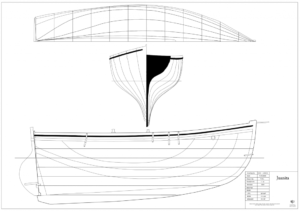
Lines Plan of Juanita with the permission of Digital Dry Dock. Website@ Ollie Graffy/Digital Dry Dock
Further Reading:
Bartlett Blog: Charles Pears – Artist and Sailor with Ties to Cornwall
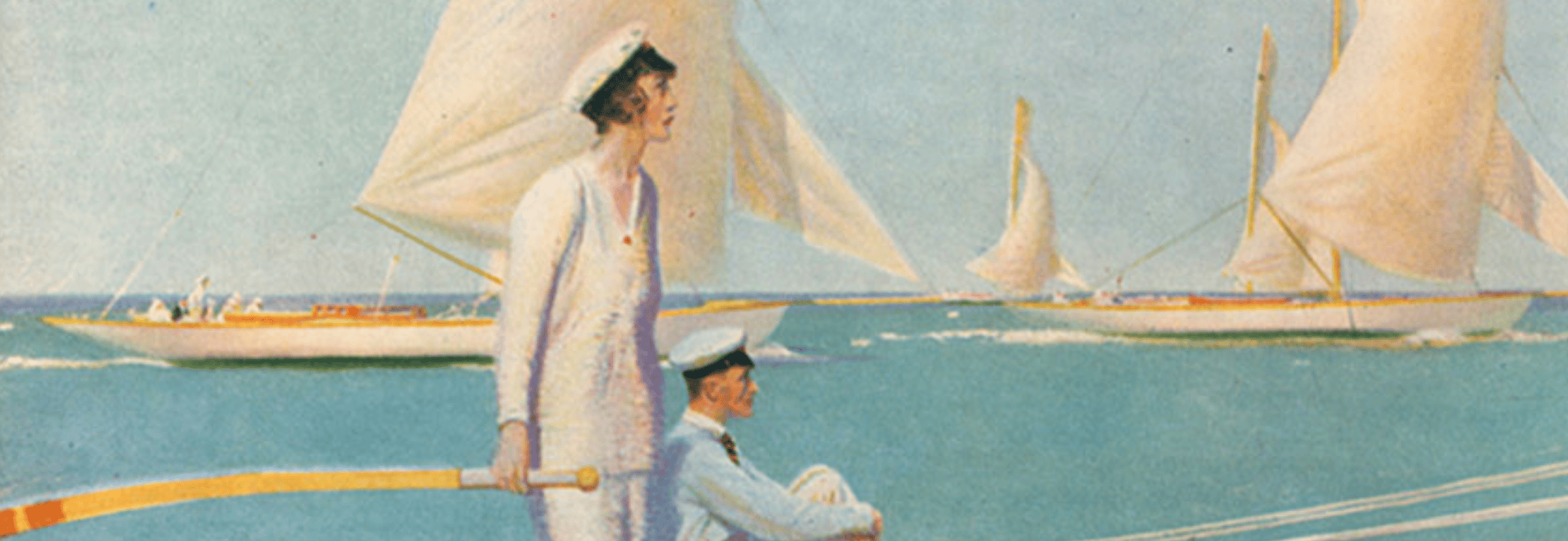
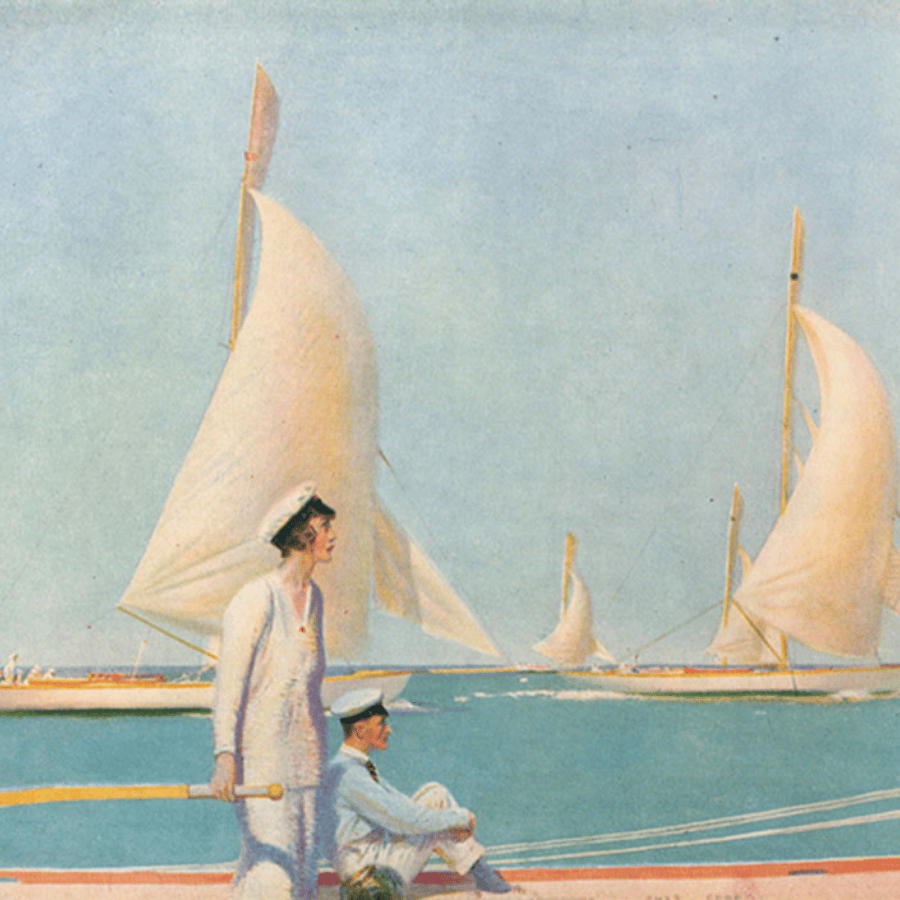
Header Image credit: The Ladies Race by Charles Pears from Yachts and Yachting in Contemporary Art published by The Studio 1920.
The Bartlett Blog is researched, written and produced by volunteers who staff The Bartlett Maritime Research Centre and Library of National Maritime Museum Cornwall. This blog post was written by Linda Batchelor, a Bartlett Library volunteer.
The Bartlett Maritime Research Centre & Library holds a Collection of over 20,000 volumes and offers access to one of the finest collections of maritime reference books, periodicals and archival material. The Bartlett Blog reflects the diversity of material available in The Bartlett Library.

National Maritime
Museum Cornwall Trust
Discovery Quay
Falmouth Cornwall
TR11 3QY
View Map
See our opening hours
Tel: +44(0)1326 313388
Email: enquiries@nmmc.co.uk