By Linda Batchelor
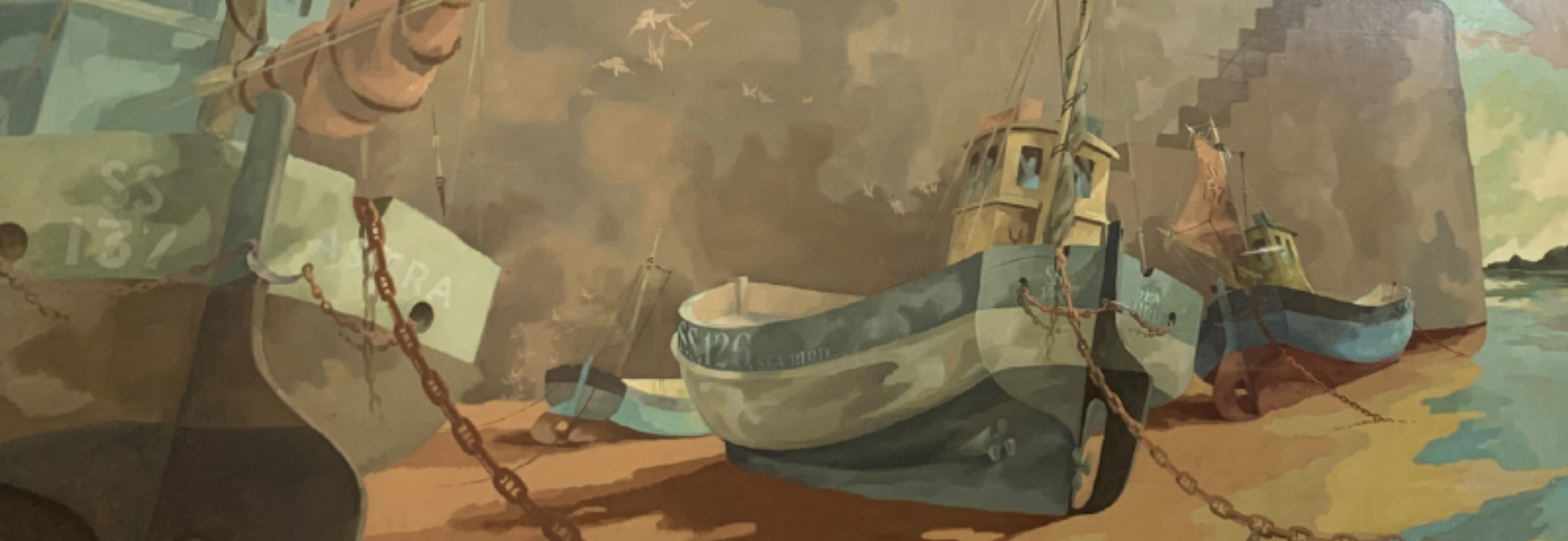
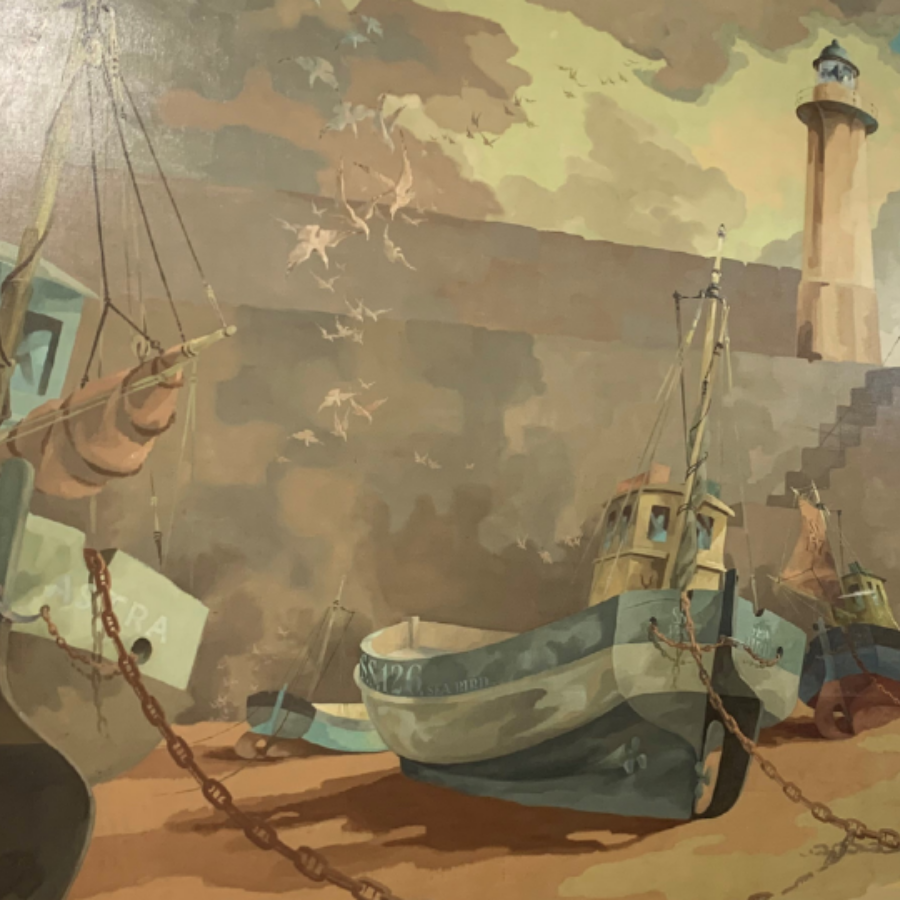
In March 2026 the House of Fraser closed its department store in Plymouth. The site has now been acquired to be converted by Babcocks International into a new Capability Centre and part of the original fabric within the building, a large mural by the artist Frederick T W Cook of a Cornish harbour scene, has now come to the National Maritime Museum Cornwall in Falmouth. The Plymouth store, originally Dingles, was an iconic building on Royal Parade, opened in September 1951 as part of the rebuilding of the city after destruction during World War II.
The Plymouth Blitz
Dingles had been founded in 1880 in Plymouth and by 1939 had over five hundred employees in several sites in the city centre and with plans to rebuild but these were put on hold when war broke out in Autumn of that year. As a major naval base the city was a strategic target for the German Luftwaffe and from 1940 was the subject of numerous and destructive air raids. On 21 March incendiary bombing started a fire on the roof of Yeos one of the city stores which spread to Dingles destroying their premises and many others in what became known as the Plymouth Blitz. Despite the loss of major premises Dingles continued to trade in a variety of sites that had survived and by the end of the war their workforce had expanded to six hundred employees.
In 1943 plans were already underway for rebuilding the shattered city. ‘A Plan for Plymouth’ was presented to the City Council and released on 25 April 1944 and reconstruction began. The Plan by Patrick Abercrombie, an architect and Professor of Town Planning at University College, London and James Paton Watson, Plymouth’s City Engineer, was a radical vision of a modern city. The proposal was for the old, devastated city centre to be swept away and replaced with the construction of a new centre based on zones formed by two interlinking grand axes, one north to south named Armada Way and another east to west named as Royal Parade.
One of the first of the major builds was a new department store for Dingles at the intersection of Royal Parade and Armada Way. The store opened in September 1951. The building, designed by Gordon Tait of John Burnet, Tait and Partners Architects of London, was originally four storeys, constructed of precast Portland Stone concrete with some mural panels on the outside of the building in the stripped classism style of the 1950s. Inside the building main stairwells were areas of minimalistic décor but here there were large painted murals on canvas of West Country themes to add colour and interest. It is probable that the harbour scene by Frederick Cook in NMMC was from this location.
By the 1950s and the rebuilding of Plymouth Frederick T W Cook was living with his wife in Polperro, in Cornwall. He was born near Hampstead in London in 1907 but had spent many holidays in the West Country. He had trained as an artist at Hampstead Art College and Willesden Polytechnic. He started his career as a poster designer including designing posters for the London County Council and London Transport. Before the Second World War he was working in London as the head of two London display firms and did design work for the Bristol Commercial Gas Association. In 1939 he had married fellow artist Margaret Anyon and when the war came he joined the Auxiliary Fire Service.
The Auxiliary Fire Service
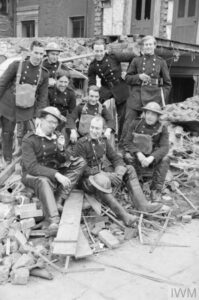
The Auxiliary Fire Service (AFS) was established as part of Civil Defence provisions under the Air Raid Precautions Act 1937 and a formal set up began in January 1938. The purpose of the service was to provide extra fire services in local authority areas through the recruitment of volunteers to augment the ranks of full-time firefighters. The London Fire Brigade for example at the time had a full-time complement of 2,500 but estimated that under bombing attack London would need a vast number of extra fire fighters. Large scale recruitment campaigns began in 1938 and over 25,000 volunteers had joined the AFS by the inception of war. In 1941 the AFS was amalgamated with local authority fire services to become the National Fire Service (NFS) which existed until 1948. 1,027 firefighters, 327 in London, died on active service.
Those eligible were young men between 14 to 18 years old, who were recruited as messengers travelling by cycle or light motor bikes, men aged between 25 to 50 as firefighters and women, recruited, for the first time to the fire service, as drivers, despatch riders, fire watchers and for clerical and ‘watchroom’ duties. Training programmes were established for recruits with sixty hours of basic practical and theoretical firefighting training.
Firemen were equipped with steel helmets, uniform trousers, waterproof leggings and rubber boots. District fire sub stations were set up in schools, garages and factories with firefighting equipment such as ladders and trailer pumps, which could be easily transported, and water tanks were mounted on adapted lorries
The bombing campaigns from the air, the Blitz, began in earnest in 1940 with fifty-seven consecutive night raids on London and its surrounds, from September 1940 to May 1941. The most intense raid was on the night of 29 December 1941 with over 100,000 bombs dropped on the city, which became known as the Second Great Fire of London, and London continued to be targeted throughout the war. The public perception of the AFS was greatly enhanced by the bravery and fortitude of the force in London and reinforced by the firefighting in other industrial and port cities which became subject to strategic bombing campaigns such as Coventry, Glasgow, Manchester, Liverpool and Plymouth.
Firemen Artists
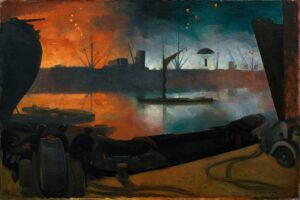
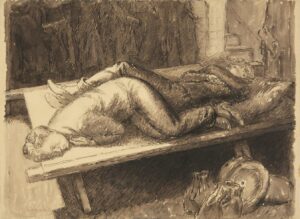
Amongst those recruited to the AFS as volunteers were those who had worked as professional artists and designers before the war and amateur artists whose wartime experiences compelled them to record the conditions, the destruction and resilience of the time. There were a considerable number of these artists who volunteered in London and other areas, who produced art works inspired directly by their practical involvement or recollections and memories associated with the AFS and NFS. They became known as the Firemen Artists and they included artists such as Bernard Hailstone, Ernest Boye Uden, Leonard Rosoman, Paul Dessau and Frederick Cook.
In 1940 the Firemen Artists Organizing Committee was formed by ten artists serving with the AFS in London with founder members including Paul Dessau, Leonard Rosoman, Matvyn Wright and Mary Pitcairn, the only female artist on the Committee who was its Secretary. The purpose was to represent and showcase the work of both professional and amateur, male and female artist members of the AFS.
By 1941 the first public exhibition of twenty two of the artists of the AFS, including works by female recruits such as Mary Pitcairn, Julia Rosenthal and Enid Abrahams, was held at the Central School of Arts and Crafts in London. The exhibition, showing over a hundred paintings and drawings, depicted dramatic incidents ‘the spectacular with the heroic’, alongside other related working scenes and portraits, all produced by the creators with a degree of authentic understanding of the work of the fire service. The exhibition ran for three weeks attracting thousands of visitors and raising the profile of the AFS and the fire services in general and they became known as the ‘heroes with grimy faces’.
British Pathe News Film, which pioneered video news journalism in cinemas, produced a 3minute 28 second black and white film entitled ‘Firemen Artists Flash!!!’ for wartime cinema news. The 1941 film was a short look at some of the artists of the AFS, adding further to positive public perception of the service.
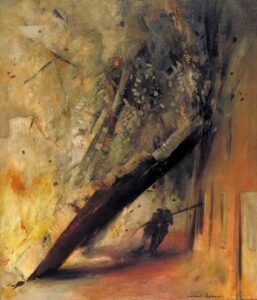
Leonard Rosoman, an artist and teacher had volunteered for the AFS and was part of the Firemen Artists Organising Committee. He witnessed this scene, which haunted his memory, when, after several hours of firefighting, he had just been ordered across the street and handed over the hose to another Auxiliary Fireman who was killed when the wall collapsed. It was one of Rosoman’s most famous paintings.
A second exhibition was held in August 1941 at the Royal Academy in London which once again attracted large numbers of the public before touring other areas of the country. The exhibition was then taken to the USA and shown in Washington entitled ‘The Great Fire of London’. It was sponsored by the British Government as a propaganda exercise to encourage US involvement in support of the war and three of the firemen artists, Matvyn Wright, Edgar Kirby and William Garrett, accompanied the exhibition to give addresses on the art works, to give first-hand accounts of conditions and engage generally with the American public. The Firemen Artists also continued to hold further exhibitions at the Royal Academy and elsewhere in Britain throughout the war.
In Britain the role of the AFS and the NFS, its successor from 1941, was a vastly important part of the Civil Defence provision and the role of the volunteers and of firemen artists continued. In 1939 the War Artists Advisory Committee (WAAC) was established under Sir Kenneth Clark, Director of the National Gallery, to provide a visual record of war at home and abroad. Several of the firemen artists were subsequently employed or given specific commissions or their work was purchased by the Committee throughout the war but many continued in the service until the NFS was disbanded in 1948 when fire service provision was returned to local authority control.
The Fireman Artist Frederick Cook’s Later Career
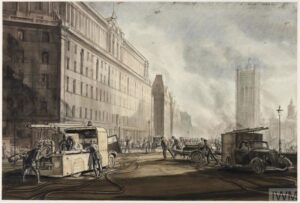
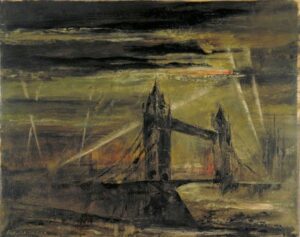
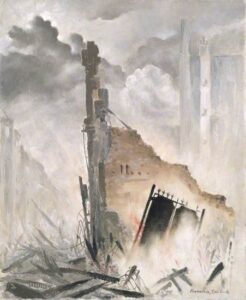
Frederick Cook had been invalided out of active service in the latter part of the war due to a back injury sustained firefighting but he continued to paint with subjects often informed by his wartime experiences such as his 1944 works entitled ‘A Flying Bomb over Tower Bridge’ and ‘Paternoster Row’. He also contributed to magazines and journals such as the Studio, Life, Sphere and Tatler. Nine of his works were also later acquired for the nation as part of the Imperial War Museum art collection.
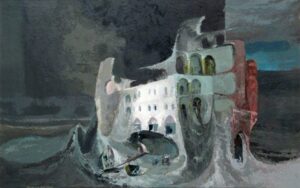
After the war in 1947 he and his wife moved to Polperro in Cornwall where they remained for the rest of their lives. They both worked as artists at their Harbour Studio which was close to the water there. Frederick worked as a painter in oil, gouache and watercolours, exhibited widely and joined the St Ives Society of Artists. He produced several works representing the damage and scars rendered on Plymouth during the war and a variety of other subjects including harbour and marine scenes, landscapes and flowers which sometimes had a brooding quality and leaned towards abstraction.
It is not surprising that as a known artist and a keen fisherman with works connected with the aftermath of the Blitz on Plymouth that Frederick Cook was commissioned to paint one of the large murals for Dingles as part of the regeneration of the modern city. It is a more gentle, peacetime, harbour scene with fishing vessels, based on an amalgam of Cornish harbours. The painting, which is not currently on display, will be exhibited in the Cornish Quayside Gallery following a lengthy conservation programme.
Additional Information:
Rebuilding Plymouth
Plymouth City Council Arts and Heritage – A Plan for Plymouth.
Collections of Wartime Art
Imperial War Museum Art and Design Collection – includes Photographic and War Artists Archive.
UK and Commonwealth galleries.
Exhibitions
Inaugural Exhibition for Firemen Artists – Central School of Arts and Crafts, London 1941.
Royal Academy, London 1941 -1945.
North American Tour 1941- 1942.
Beauty and Destruction: Wartime London in Art. Imperial War Museum 20 March – 1 November 2026.
Film
British Film Institute National Archive. British Pathe Newsreel ‘Flash’ 1941.
The Bartlett Blog is researched, written and produced by volunteers who staff The Bartlett Maritime Research Centre and Library of National Maritime Museum Cornwall. This blog post was written by Linda Batchelor, a Bartlett Library volunteer.
The Bartlett Maritime Research Centre & Library holds a Collection of over 20,000 volumes and offers access to one of the finest collections of maritime reference books, periodicals and archival material. The Bartlett Blog reflects the diversity of material available in The Bartlett Library.

National Maritime
Museum Cornwall Trust
Discovery Quay
Falmouth Cornwall
TR11 3QY
View Map
See our opening hours
Tel: +44(0)1326 313388
Email: enquiries@nmmc.co.uk